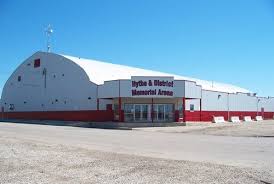
I was bragging to my son-in-law the other day about how good the ice is at the Fuller Lake arena. He asked what made some ice better than other ice, and all I could think of was that the closer it is to natural outdoor ice (unmarred by early snow or ruined by a chinook), the better it is. I told him about the ice at the Hythe, Alberta, arena, which at one time, was natural and depended entirely on cold weather. Built in 1950, the Hythe Arena is apparently the oldest arena north of Edmonton, and it is chock full of character—especially when the bleachers are packed with screaming hockey fans.
Reminiscing about Hythe’s ice reminded me of one of my favourite stories about the place.
We were on the Flyers’ bus heading home from a game there against the Hythe Mustangs. I was sitting next to a pair of young fellows from Edmonton who were playing with us that year. Our goalie, and an old friend, Gary Ford, was sitting nearby. I don’t remember all the details but a conversation started when one of the young guys asked a question about the goal judge “perch” in the old rink. It wasn’t long before the bullshit was getting pretty deep.
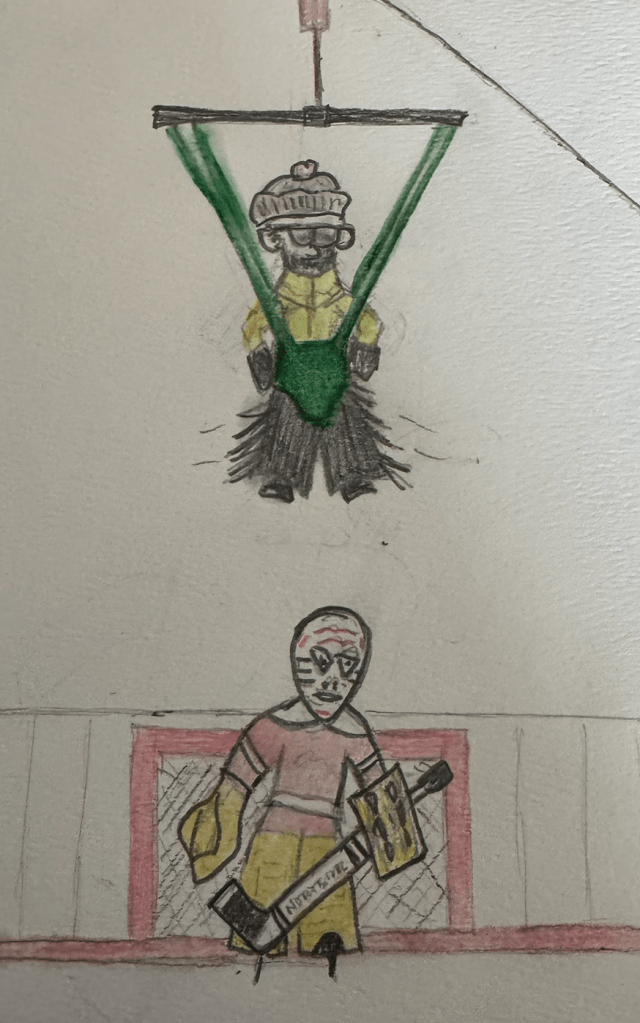
Gary… bottom left, me… top right
The goal judge’s seat was unique because the rink’s end boards also formed part of the building’s south end wall, so there was no room for the goal judge to sit or stand at ice level. Instead, he or she had to climb a ladder and walk along a narrow catwalk to get to a seat that was basically right above the net. (It might have been the best vantage point any goal judge ever had!) That part is true. The rest isn’t.
Gary and I explained that the ladder and platform were a step up from the old days, when the goal judge would actually be strapped into a harness—much like a baby’s Jolly Jumper—and hoisted above the net using a rope and pulley system. The rope would then be tied off to a large cleat to secure the dangling judge in place. A “rink rat” (a boy who scraped ice and did odd jobs in exchange for free ice time) was tasked with raising and lowering the judge before and after each period.
This system worked well for a number of years, until the night the Mustangs won their first SPHL championship in the early 1960s.
The final game was an intense nail-biter that went into double overtime before Harold “Flukey” Kjemus scored the winning goal—into the net at the north end of the arena. The celebration was wild, with players and fans pouring onto the ice. At that time, the arena’s entrance, concession, lobby, and dressing rooms were all at the north end.
Meanwhile, Ernie—the goal judge at the south end—was still strapped into his harness, dangling above the net. Ernie was an unassuming, unmarried, quiet, and hard-of-hearing Hythe cowboy. It was bitterly cold that night, so he wore a knitted curling sweater, a heavy toque and his insulated chaps.
Because it was so cold that March night the celebrations quickly moved from out on the ice to the much warmer lobby and dressing rooms at the north end. The forgetful rink rat on duty joined them.
When the happy and somewhat tipsy crowd finally left the arena later that night—from the north end—Ernie, whose voice was surely hoarse from yelling for assistance, was still hanging there.
Sadly, that playoff game was the last time the arena was used that winter. It sat empty as spring time arrived and the natural ice slowly melted into the gravel base.
Gary and I told the young fellows that Ernie had tragically perished and his decomposing body, chaps and all, were not found until it was time to put in new ice the next fall.
Had they not seen the memorial plaque in the lobby??
Up to that point, I’m pretty sure they believed us. But when we added that, as a result of the tragedy, the CSA required that all new “Goal Judge Hangers” have an emergency release device, they started to get skeptical. They finally called bullshit when we claimed that another goal judge perished the next year, falling to his death after pulling the previously untried “emergency release” cord. As a result, the ladder and narrow catwalk were built the very next year.
(I don’t actually remember which parts of the “story” were mine and which were Gary’s, but I absolutely remember the fun and the laughing.)
It has been a very long time since I’ve posted on this blog. I’m not sure if I have a reason. Time just went by. It’s not that I haven’t considered memories or topics that are blog worthy… I just haven’t sat down to do it. That being said, a lot has happened since my last post in February, 2022.
Most people are already aware, via Deb and my Facebook and/or Instagram posts, that I had a heart attack in May, 2023. It was quite an experience and I’ve told the “story” many times already (as most of you who know me can already imagine). I’ve been encouraged by several people, including my family doctor and, most recently, my cardiologist, Dr. Chris Franco, to let people know about my close call and subsequent “journey” this past year.
At my latest meeting with Dr. Franco, after telling me that my recent echocardiogram and blood work showed encouragingly positive results, he suggested that I formally tell my story. He said that new patients could benefit from hearing about my journey and, most importantly, the story might encourage people not to ignore chest discomfort, constriction and/or pain.
So, at the risk of boring those who’ve heard it before, here goes.
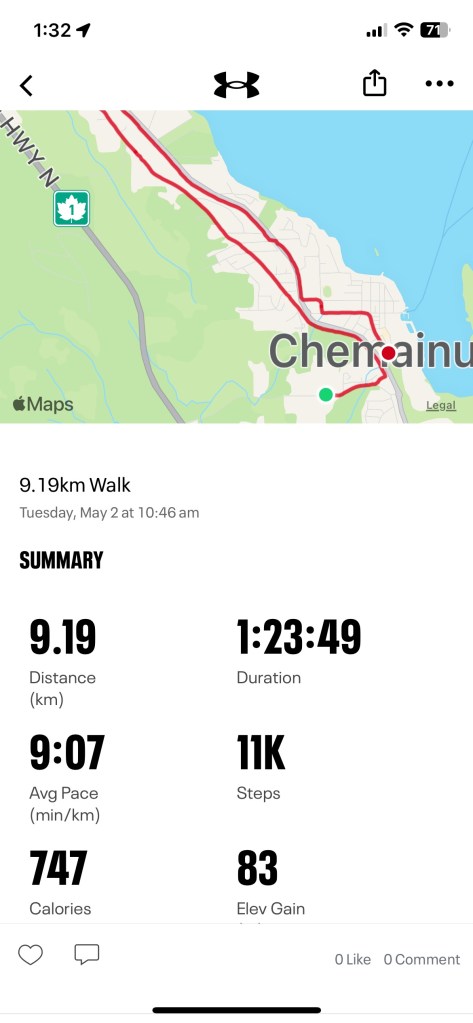
Screenshot of my morning walk on May 2
On Tuesday, May 2 I went for my usual morning walk. Since my last health scare (click here to read that one), walking has been the only exercise that feels good. I tried to walk quickly and, for several months I’d been walking 10 km most days. In fact, the morning of my “episode” the fitness app on my iphone had recorded 9.19 km and 11,000 steps. I hurried a bit more than usual that morning because I was to meet Deb and our friends Richard and Cathy for lunch in downtown Chemainus. I hadn’t left myself quite enough time so my pace was faster than usual. I felt fine during lunch, in fact, Richard and I planned to ride our bikes to Crofton afterwards. Deb and I went home and, because we had picked up a parcel that we wanted to open, she came in the house with me rather than just drop me off and go shopping. That was my first lucky break. After opening the parcel I got dressed in my fancy bike shorts. As I was coming back downstairs I started to feel a tightness in the middle of my chest. I had a Tums and a glass of water. I mentioned to Deb that the idea of a bike ride didn’t sound as good as it once had. I phoned Rich to cancel and was about to lie down on the couch when Deb asked what my heart rate was according to my Apple Watch. It was 125 and I hadn’t been walking for over an hour. We decided that Deb would drive me to the Care Clinic in Chemainus (thank goodness she didn’t go for groceries as she had previously planned). In hindsight, I probably shouldn’t have taken the time to change out of my bike shorts, and trade my slip-on crocs for tie-up shoes, because by the time we’d made the 4 minute drive to the clinic the pain was becoming unbearable and I was slipping in and out of consciousness. Apparently, I slumped to the ground as I got out of the truck and required the help of passersby to get to the doors of the clinic. I don’t remember many details… but Deb does. (There was some confusion but, to be fair, knowing what we know now, we should have called the ambulance from home and skipped the Primary Care Center altogether. They are not open all the time and are not full fledged emergency rooms. Good to know.
Deb was able to make clear that I still have the remnants of a cavernous malformation at the base of my brain. So, because of the possibility of creating another such “brain bleed” the doctor was not able to give me a shot of the “clot buster” drug. This meant the myocardial infarction (heart attack) continued at full speed. I remember the ambulance arriving and hearing the doctor say “lights and siren, boys”. A nurse, who was just about to go off-shift, volunteered to ride with me. She held my hand the whole way and cleaned me up when I was sick to my stomach more than once. The ride seemed to last forever but I know they made good time. I’ve told people that I’ve never passed a kidney stone or delivered a baby so I won’t try to compare the pain, but I know I wouldn’t have wanted my chest to hurt anymore than it did that day.
Once at the Royal Jubilee Hospital in Victoria I was immediately transported to the CCU (Cardiac Care Unit) and an angioplasty was performed. I was awake during the procedure which was done through my wrist using the carotid artery. Two stents were inserted. I was told that one stent was placed where there’d been a 70% blockage and the other at a spot that was 100% blocked. (I am still confused about how I was able to walk almost ten kilometres that morning with a 100% blockage?)
Once the stents were in place the pain subsided significantly but not altogether. There were so many doctors and nurses in and out of my room during those first hours that their faces and names are a blur. However, later that evening when the danger seemed to be over I remember meeting Dr. Franco for the first time. He told me the details about the both blockages and stents. He then told me that because my heart attack had been full on for so long that considerable damage had been done to my heart. My left ventricle, in particular, had taken quite a beating and a good portion of the tissue was dead. I learned the term “ejection fraction” that night. Apparently, a healthy heart sends 60% of the blood that’s in it out to your body with each beat. Because of the damage to my heart, my “ejection fraction” was only 30% (which basically means that I now get only about half of the oxygenated blood I used to get with each beat of my heart).
It was decided that because of the damage to my left ventricle I should stay an extra day in hospital to be “monitored”. So, instead of checking out on Thursday morning, I would go home Friday morning. It turns out that decision saved my ass.
On Thursday morning I said good-bye to the CCU staff before being wheeled down a seemingly endless corridor to the ward. Deb and I admired my new room (couch and all) for a few minutes before I had a much needed shower and put on a fresh pair of pyjamas. I got comfortable on my new bed and then called Cy to tell him that things were all in order and that I’d be going home the next day. He was driving from Fort St. John to Edmonton and was somewhere around Valleyview when we spoke. I said good-bye and then started to listen to Deb read texts from people who knew I’d had the heart attack. Moments in to that I had the first cardiac arrest. I don’t remember much of the next few hours so some of what comes next has been told to me by Deb, Makari, Brit and Adam who, sadly, were witness to some “Code Blue” stuff that you usually only see on television. Paddles, “clear!”, and energetic CPR.
Deb says that as she was reading she heard me gag. She looked over to see my eyes roll back. I’m guessing it wasn’t all that attractive. She jumped to the door to call for help but the telemetry system hanging around my neck had already alerted the staff and the first Code Blue was under way.
After, what I’ve been told, was 65 seconds, I woke with eyes wide open to see doctors and nurses surrounding my bed. My most vivid memory is of a tall nurse leaning over me on my left side. I saw that his name tag said “Lee” and found out later that he’d administered the CPR that brought me back. I don’t remember any pain at the time, in fact, although I saw no light, tunnel or angels, there were seconds (or milliseconds?) of peacefulness. Just as I began to get reoriented I became nauseous. I said so and then my heart stopped again. Code Blue #2. Deb remembers that I was awake for about 10 minutes between them. That’s about nine and a half more minutes than I remember. My next memory is of being wheeled at high speeds back down that same endless corridor. Shock pads were on both sides of my chest and I remember feeling like the shocks were lifting me off the gurney one side at a time.
The next few hours in CCU are nothing more than a blur for me. I’ve been told my heart stopped (arrested) four more times. Eventually, by early evening, I was stabilized and awake enough to start remembering and understanding things. When I saw my son, Cy, walk into my CCU room it hit me that things might be a bit serious. My daughter, Makari, had called him just as he was getting to Edmonton. He then drove directly to the airport and flew to Victoria on the first flight he could get.
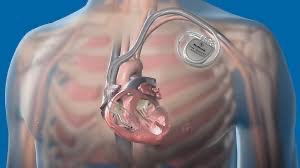
At some point Dr. Chris Franco, the lead cardiologist, came in to explain that his team had determined that I should have an “ICD” installed the next morning. “ICD” is short for a combination pacemaker and “implantable cardioverter-defibrillator”. I was told that mine would be the Cadillac model called the “CRT-D” (Cardiac resynchronization therapy with a defibrillator) and that I should refer to it as my “ICD” and not a pacemaker. As pretentious as that may sound, that’s what I now do.
The device would be installed early the next morning. Dr. Franco then explained that just in case my heart needed to be kick-started again before that, an “emergency defibrillator” would be installed right away. So, with my eyes rolled as far to the right as they’d go, I tried to watch as a they inserted what was basically a large drinking straw through a small hole in my neck a couple of inches below my right ear. A couple of stitches kept it from sliding all the way into my chest cavity. Once the straw was in place a wire was inserted that went directly into my heart. It was to dangle there and would be used only if my heart decided to take another break.
the “emergency” defibrillator
Dr. Martin van Zyl, the electrophysiologist, came in later that evening to let me know that he and his team would be installing my device in the morning and he explained the basic procedure. He would make a “pocket” under my skin in front of the muscle just below my left collar bone. Three wires, one of which is the defibrillator, would be slid down into specific areas of my heart. These wires would then be attached to the device, which is about the the size of a small tape measure, before being inserted into the newly created pocket. Then, using a few stitches, the pocket would be closed up.
CRT-D… the Cadillac
Dr. van Zyl, was confident and upbeat. I’m not saying he was young but I’m pretty sure I taught his grandpa in Grade 6. Before leaving he told me to get a good night’s sleep. I smiled and told him that it was more important that he sleep well. He laughed.
After the doctor left, Deb and the kids came into my room. Although some memories of that time are a bit blurry, I do remember telling them that I wasn’t really afraid and that I felt pretty good about the doctors’ plans. I remember telling them that if things went south my idea of heaven would be that they smiled whenever they thought of me… just like I do when I think of Mom or Dad. I told them a traditional heaven in the clouds would probably be crowded and tiresome after awhile. I don’t remember exactly how it came up but we did talk about them each getting a “Live, Love, Larry” tattoo. (The idea has since been downgraded to t-shirts instead.) 🙂
My heart operated without any help that night but falling asleep was a bit tricky. In fact, my nurse, Andrea, spent much of the early morning hours sitting with me in the dark talking about kids, careers, and camping on Vancouver Island.
At about 6:30 am a smiley orderly came to prep my chest. Yeehah. A few minutes, some warm water, a couple of disposable bic razors, and the left side of my chest was as bald as it had been when I was a pre-teen. Just before 8:00 am, members of the electrophysiology team, including Dr. van Zyl, came to wheel me to the operating room. I remember telling them that I’d turned 65 only a few months before and I was hoping things would go well because I’d only had a couple of free BC Ferry rides so far. I also mentioned my only allergy was to pain so I hoped they wouldn’t be stingy with the anesthetic.
I was awake for the procedure, which lasted about an hour and a half. I had the perfect amount of fentanyl so I didn’t feel a thing and was in a bit of a holiday mood. Although a screen over my face blocked my view, I could hear everything that went on. The team of six or seven people worked like a well oiled machine while Top-40 music played in the background. They spoke to one another like a group of really good friends working on a car engine (in this case, a vintage car engine). Dr. van Zyl was the boss but not bossy.
Listening to this group of professionals at work was the first step towards developing some confidence in this new contraption that will now live in my chest for the rest of my days.
After the “installation” was complete, I was wheeled back to CCU where I was to spend the next two nights. Again, the care was amazing and constant. I was hooked to lots of bells, whistles and lights, and I received a number of needles and echocardiograms. The only pain I had was from my badly bruised ribs. When I mentioned the pain I was told that if my ribs weren’t a little bit sore I probably wouldn’t be around to complain about it. Made sense.
My mind was too busy during those first hours to have any real feelings of fear or sadness but a couple of things did happen to put things into perspective.
The first was when I took my first walk. My nurse, Andrea, told me that I’d been ok’d to get out of bed and try a slow walk. It was the middle of the night and I couldn’t get to sleep anyway so I thought it might be a good idea. She helped me off the bed and I held her arm. I grabbed my IV stand with my other hand and then we headed down the hallway. We were moving slowly as we rounded a corner and approached the nurse’s station. A shift change was taking place so there were five or six nurses huddled there. When one of them saw us she started to clap slowly. Then they all did. The nurse who’d been sitting actually stood up. It made me smile and tear-up all at once.
The second shot of reality came when Dr. Franco made his rounds the next day. When he asked how I was feeling I told him that I felt ok but didn’t feel like running any races. His response was, “That makes sense. You died three times yesterday and your heart is really sick.” I was beginning to see what the starting point of my recovery would be.
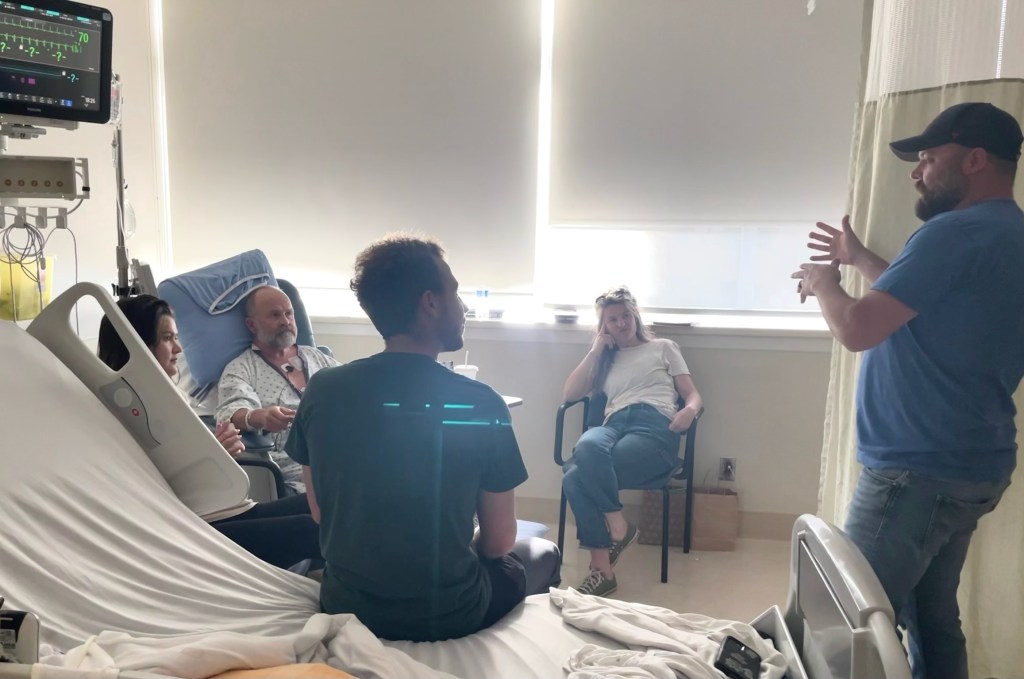
the kids…
Mike and Carol
I was moved back to the ward and spent the remainder of my 11 day hospital stay there. I had regular medications, needles and scans while also hosting several much appreciated visitors.
I especially need to mention that my sister and brother-in-law, Carol and Mike, flew in from Calgary to be with me. (That’s the second time they’ve done that… I love them and I owe them!)
The amazing care and attention continued in a humbling way even after I got home. Two words describe my caregivers… brilliant and kind.
(Some day I might share the details of the home-care, physio rehab, and on-line support in another blog post.)
a pill box just like my Gramma used to have!
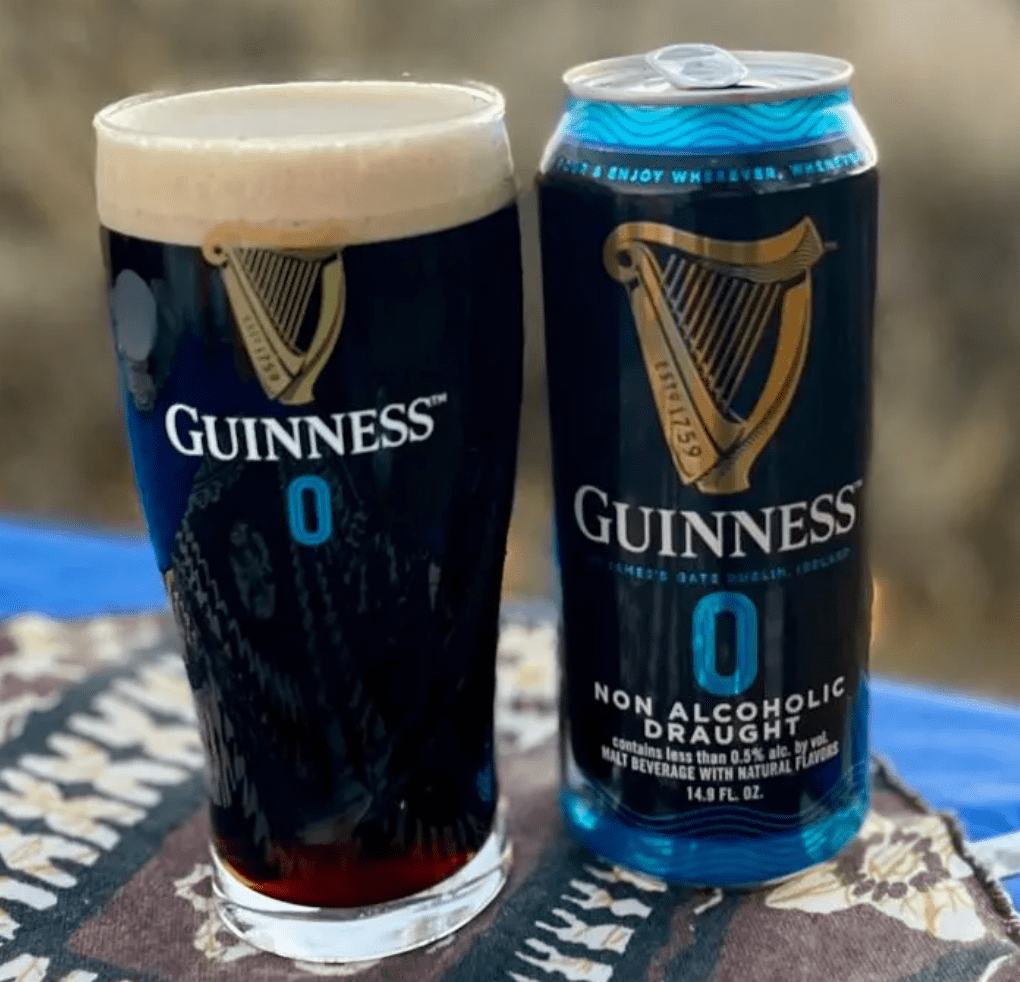
‘near-beers’ keep getting better!
As I write this it is dawning on me that considerable time has passed and that I’m getting used to the daily medications and having this rock-like thing in my chest. I’ve also come to realize that although there are multiple downsides to having a heart attack, there have been some interesting upsides. I’ve lost 20 lbs that I didn’t need to carry around any more, I haven’t had any alcohol since the “event”, and I feel that I’ve had longer and more meaningful conversations with Deb and our kids in these past months.
Willie
Although my recovery has gone well, I’ll admit to days of fatigue, overthinking, melancholy, and some downright feeling sorry for myself. That being said, I’m happy to say that I’m back to walking 10,000 “steps” most days (special thanks to Willie for the inspiration), playing guitar (thanks to the other Willie for that inspiration), and getting back to living.
My love and gratitude to Debbie Mah 🙂
PS. When I write my book, the title will be: “My Stories Are Always Long”
My Gramma Espe came to Canada in 1929 at the age of 25. She spent most of her time living and working with other Norwegian immigrants so learning English was … Continue reading “Vindy at Wigdal’s”
Montney had a thriving “community club” when I was small. We kids generally took for granted that our parents were the volunteers who operated and maintained things like the community … Continue reading Montney goes Hollywood
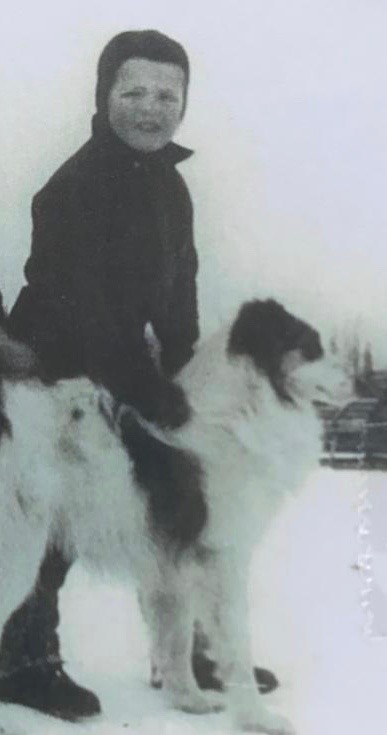
Dad with his dog at the farm in Montney (circa 1939)
During these crazy times I know that many parents are doing their very best to “home-school” their kids. Many homes will have traditional school supplies like pencils, paper, crayons, and paints on hand and, for those with the technology, there are lesson ideas and curriculum posted on-line. Other great learning resources such as kitchens, gardens, and families eating dinner together are often available and shouldn’t be overlooked.
My worry is that parents will think that they have to set up an environment that mimics what they remember about school… whether it was good or bad. “One-size fits all” isn’t a good thing.
By far the most important ingredient for learning is the relationship between teachers and their students. That part can’t be forgotten at home either. Being boring and unreasonably “strict” are no longer considered acceptable strategies in most schools. For example, talking louder (i.e. yelling) doesn’t make learning happen faster. In fact, it’s quite a bit like trying to steer a car with the horn.
Ultimately, we are ALL teachers at some point in our lives. What follows is some advice from one of the best:
Deb started working on her Master’s Degree in about 2001. One of her assignments was to research positive school experiences from years gone by. She got the idea to interview my dad during one of his visits.
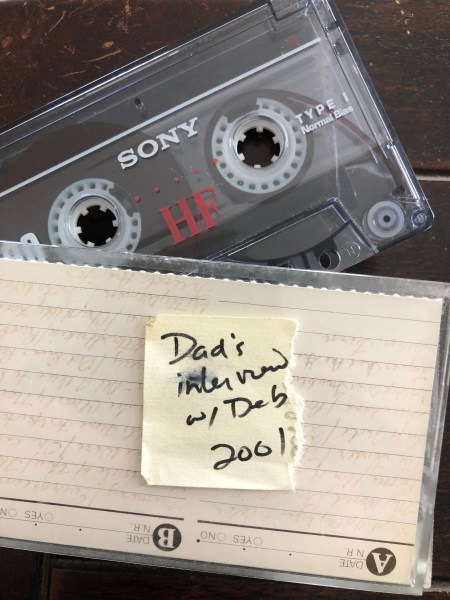
Recently, we found the almost-twenty-year-old cassette tape of their conversation. Luckily, we also found an old “ghetto-blaster” that would play it.
We listened to Dad talk about going to school for the first time in June of 1939 just to learn some English. He was 7 and, at that point, spoke only Norwegian. He also explained why there was an “ice house” in the school yard. He said, “We were primitive. Really primitive…” but you can almost hear the smile on his face as he says it.
The lesson for us all came when Deb asked him about what made someone a “good” teacher. He spoke of a young teacher who had a good personality that made her “fit in”. In his next breath he talked about an “old teacher” who he said had no personality. “I don’t know what she had… I don’t even think she had teeth. I think that’s why she didn’t smile. She didn’t have teeth.” You can listen to Dad by clicking on the picture below:
So… the advice from my dad for teachers (and remember, we are ALL teachers!): Have a good personality, fit in, and keep a smile on your face.
Pretty sound advice, I think.
Post Script:
One year ago today I flew to Edmonton, rented a car and drove to Camrose to see Dad in the hospital. He had been admitted the night before and was in dire straits. He was hooked up to a high-powered ventilator. I spent the next five nights with him before he passed away peacefully on April 6. By then just about everyone was in the room to say goodbye.
This terrible virus we are now all dealing with doesn’t allow families to say good-bye like we were able to. That breaks my heart. It makes me appreciate even more that we were able to talk with, sing to, and hold hands with Dad during his final hours.
Please stay home if you can. Don’t be a rebel to prove how tough you are. Remember… even “heroes” like John Wayne and Tom Cruise use stuntmen and Superman came from a comic book.
The real heroes are the caregivers and essential service workers who are still on the job for our sakes. A heartfelt thank-you from a distance.
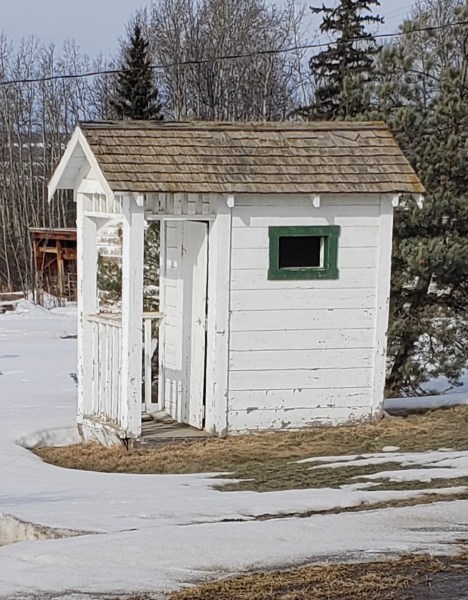
A recent picture of the outhouse behind the old Montney General Store. Still looking pretty fine! Thanks to Lori Jeffrey for sending me the picture!
(Toilet paper hoarding and social distancing have quite a bit to do with the timing of this story.)
The “old” Montney General Store didn’t have running water, and when the “new” store opened in 1962 the residence at the back didn’t either. Mom, Dad and four-year old me lived within the stud walls and walked on the plywood subfloor for a few months. The bathroom was the last room to be finished. I bathed in a galvanized tub (I can’t remember what Mom and Dad did?). We had a portable toilet that was vented but, it still had what Dad referred to as a “honey-bucket” which needed to be carried out and emptied. To limit the number of times he had to make the trip, Dad urged us to use the outhouse when the weather was good. It stood just 30 or 40 meters south of the back door. In fact, long after our new-fangled flush toilet was installed, Mom kept the outhouse clean, painted and usable. I think it was because it was such a great little building with curtains on the windows, two seats, and a cute little veranda on the front. Mom bragged about the compliments it received.
That outhouse was still sitting in the same spot the last time I visited the Montney corner.*
During the summer of 1978 after coming home from college I lived in my grandparent’s house on the farm just two miles south of the store. The little house had been empty for a while so it needed some TLC. We were able to make it quite cozy and comfortable but had to do without running water. Again, I was forced to bathe in a galvanized tub and visit the outhouse. Thankfully it was warm summer.
I know it sounds like an “old man” story, but visiting an outhouse was still a pretty common thing to do in the rural Peace Country during the seventies. The fibreglass and polyethylene portable restrooms that we all know and love from our visits to music festivals and rodeos didn’t even hit the market until the seventies.**
So… it was an interesting coincidence that the same summer saw me participate as part of a 4-man team in Fort St. John’s “4th Annual Outhouse Race”. I’m not sure of its full history but I know that the first race took place in 1975 and the last in 1993. Over the years the race transformed. Early years saw groups of guys wearing work-boots pushing actual outhouses fastened to a set of casters. Many of the racers had beer in hand. The petrified (and sometimes half cut) “driver” sat inside looking out an open door. In a 2011 Alaska Highway News article, Fort St. John’s resident historian, Larry Evans remembered that, “at first, some of the outhouses were really heavy but they evolved over the years to light plastic with bicycle wheels. It pretty much disintegrated into running races and, boy could they ever go.”
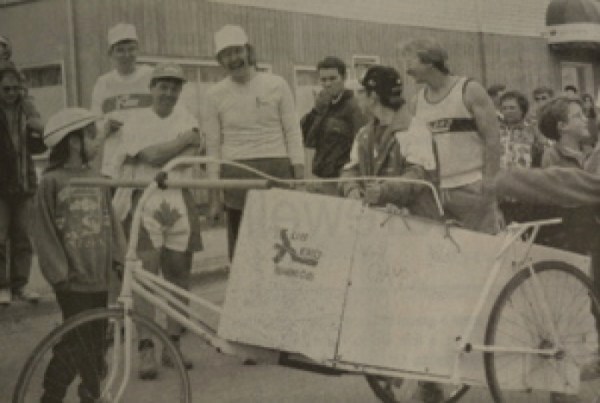
The SubZero Running Club’s “Outhouse”. No wonder competition was stiff!
By 1978 many of the “outhouses” were that in name only. Although there were still some old fashioned heavy ones, there was at least one that looked quite a bit like a guy on a 10-speed bike wearing a cardboard outhouse costume. Even our outhouse was just a lightweight wooden box mounted on a 2-wheeled cart. It reminded me a bit of the pony chariots my Uncle Jim and cousin Gary used to drive. The contraption was nice and light but using it as a bathroom would have been messy.
Our “outhouse” was sponsored by Moe Martin of Moe Martin Chevrolet Olds. Moe was on the executive of the Golden Hawks hockey club so I guess that’s why myself and three other Golden Hawks were asked to pull his outhouse. Moe’s young son, Peter, rode inside the thing. We couldn’t really call him our “driver” because he had absolutely no control of where, how fast, or how slow we went.
I’m pretty sure there were a few different routes used over the years, but in 1978 we ran an approximately 650-meter circuit in downtown Fort St. John. We started in front of the Bank of Commerce at 100th Street and 100th Avenue. We ran west to the Lido Theatre where we made a right turn. From there it was up to the Post Office (the halfway mark) and then back towards 100th Street where the finish line was beside the same bank.
Our team consisted of my good buddies Kim Henry, Del Parker, Brent Esau and myself. We met downtown that afternoon dressed in our bright yellow (gold?) Golden Hawks t-shirts and Moe Martin ball caps. It was a chilly afternoon and there had been a significant Peace River downpour just before the race was to start, so none of us bothered to take our sweat pants off. That proved to be a mistake. Our two-wheeled out-house had a t-shaped bar that was originally designed for us to stand behind and push. However, at the last minute, someone had what they thought was a better idea. Instead of pushing, we decided to use short lengths of rope to tie ourselves to the bar so that we would be pulling it instead. This idea would leave our arms free and it seemed to make sense.
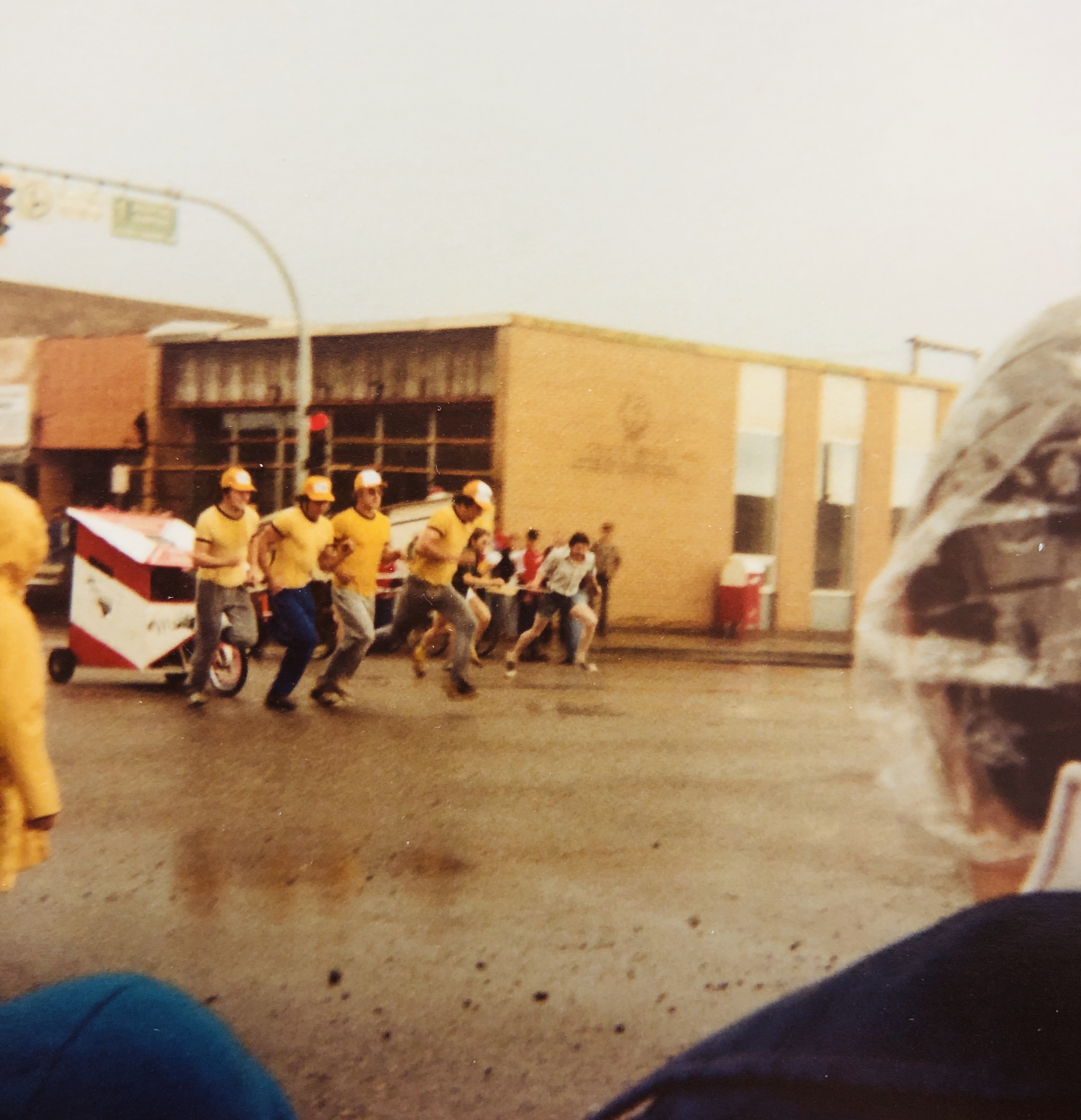
At the starting line. Left to Right: Me, Brent, Del and Kim. You can see Kim setting the pace! Note the rain gear on the spectator in the fore-ground.
We lined up shortest to tallest with the shortest guy being on the right-hand side. I was the shortest and didn’t mind the order because it meant I’d be on the inside for all three corners and, by my calculations, wouldn’t actually have to run as far as the other guys. That was another strategy that seemed to make sense at the time. Brent was next to me, then Del, and then Kim, who was tallest.
Only two outhouses raced at one time. This was a good thing because there wasn’t much room for more than that. The streets are quite wide, but as Larry Evans recalled, “they would have three or four thousand people come downtown and we had a hell of a time keeping the paths clear so the outhouses could get through.” The crowd was huge despite the rain and I remember being really nervous as we took our turn at the starting line.
I don’t remember us talking about a “pacing strategy” at all and I’m fairly certain that we all took off expecting to sprint the entire distance. Obviously, we were all in much better shape then but there were still some things we hadn’t considered. Kim was fit and had really long legs. Del was a great runner with a “we-must-win” attitude, Brent and I, on the other hand, were two short legged guys who were just in it for the cold beer waiting at the finish line.
The first few meters flew by… MacLeod’s, Marshall Wells, and the Condill Hotel were just a blur. Then reality and mother nature kicked in. The rain that had poured down shortly before the race had now become foaming rivers running along the curbs. A small lake had formed at the Lido corner and, as I was on the inside, I was plunging through water up to my knees as we made the sharp right turn. If you’ve ever owned a pair of Russell sweat pants you will know that they become noticeably heavier when they are wet.
As we headed up towards the Post Office (and a I do mean “up”!) I began to realize that my lungs were on fire, my legs were seizing and my sweatpants were falling down. I didn’t have any breath left to ask my teammates for mercy and I don’t think my pride would have let me anyway.
The last half of the race is a blur. I don’t remember seeing the Dairy Queen, the IGA or any of the people who later said they’d been on the sidewalk cheering us on. I tugged at my pants when I could and doggedly put one foot in front of the other. Although I was in agony, I knew full well that Del and Kim would drag Brent and me across the finish line if either of us fell. Being tied to our load left us no choice but to keep moving. At some point my life actually flashed before my eyes.
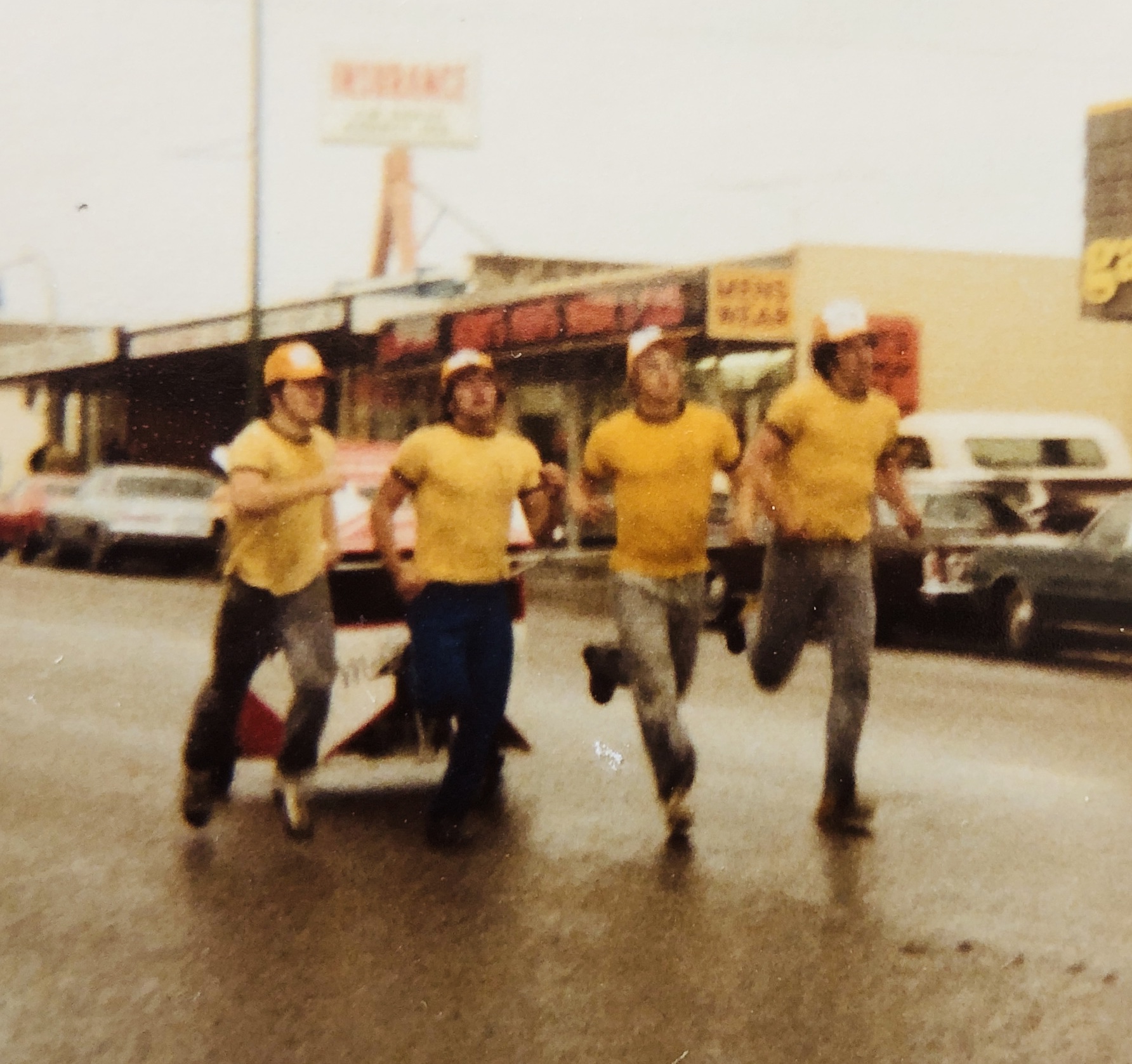
Moments from the finish line… the tank was pretty much empty.
I don’t remember crossing the finish line, or even caring. I just remember the taste of blood at the back of my throat and the fact that, for what might have been the first time, I didn’t enjoy the cold beer that was handed to me. If memory serves, I think we placed 3rd.
Thankfully in a few hours I’d fully recovered. My thighs were a bit sore but all else was good. If that had been today I would have to be admitted to the Intensive Care Unit.
In 2011, there was an attempt to get the race going again after an 18-year hiatus. It didn’t happen. Too bad. I think everyone should run in an outhouse race. It makes you appreciate your health.
*I couldn’t find a picture of the outhouse at the Montney corner. If someone from up there takes one and sends it to me I will add it to this post! espelarry@gmail.com
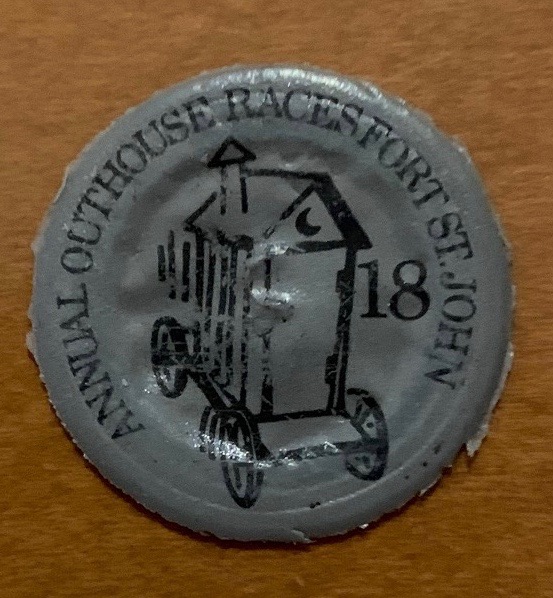
PS. After reading this story, Tim Galbreath e-mailed me this picture of a Coca-Cola bottle cap liner (remember those??) from back in the day. Apparently, Coke was impressed by Fort St. John’s Outhouse Races! Very cool. (Thanks to Tim for sharing).
Coca-Cola bottle cap liner… (photo credit: Tim Galbreath)
My son will be 38 in May. My mom was 38 the year I left home.
I was 15 in early September of 1973 when my friend, Del and I moved to Smithers to play hockey. Our moms took turns driving the ten hours it took to get there from Montney. We sat in the back seat excited and anxious. We were pretty sure that being assigned to the Smithers Nat’s, although only Junior B, was the first step on our journey to the NHL.
When our moms hugged us and said goodbye the next day they were crying. We were too cool to hug too tightly or to shed any tears. Our tears would come later when the homesickness set in.
In that busy first few days we met our billet family, started school and were re-introduced to the other fourteen or fifteen guys who had been invited to Smithers after the main training camp. The camp had been in Kamloops a couple of weeks earlier. While there we had competed against one another for our place on the roster but now we were meeting for the first time as teammates.
The guys were from places like Coquitlam, Vancouver, Quesnel, Kamloops, Yellowknife, Merritt, Prince George, Hythe, Fort St. James, and Smithers. Two of the guys were sixteen-years old, two were fourteen-year olds and the rest of us were 15.
The Pacific Northwest Hockey league spread along Highway 16 from Prince George (the Spruce Kings) in the west to Prince Rupert (the Halibut Kings) in the east. There were ten teams… five were senior teams and five were Junior B. Being in Smithers was handy because we were right in the middle.
Our team, the Nat’s, had won the league championship the year before and the players, it seemed to us, were heroes in the little hockey town. Because they’d done so well, most of them had moved on to play at higher levels, but when we started school at the old Smithers Secondary we were able to ride on their shirttails for a few weeks. We received lots of attention and were treated well. It may have even gone to our heads just a bit.
Once the hockey started in October, however, reality set in. We took some humbling drubbings. I guess our excuse could have been that we were so much younger and smaller than everyone else, but excuses don’t make losing any easier. And being homesick made it even harder.
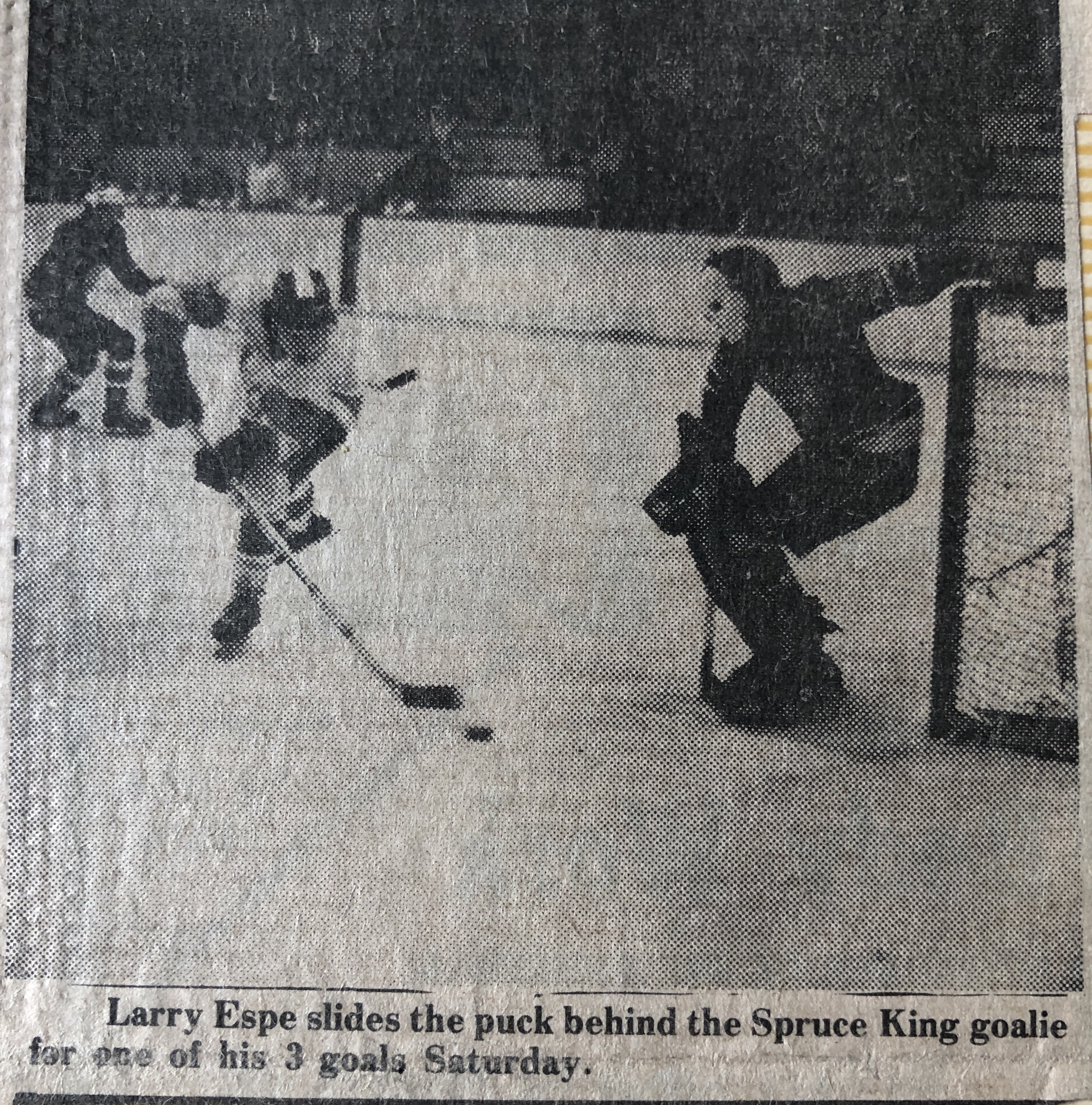
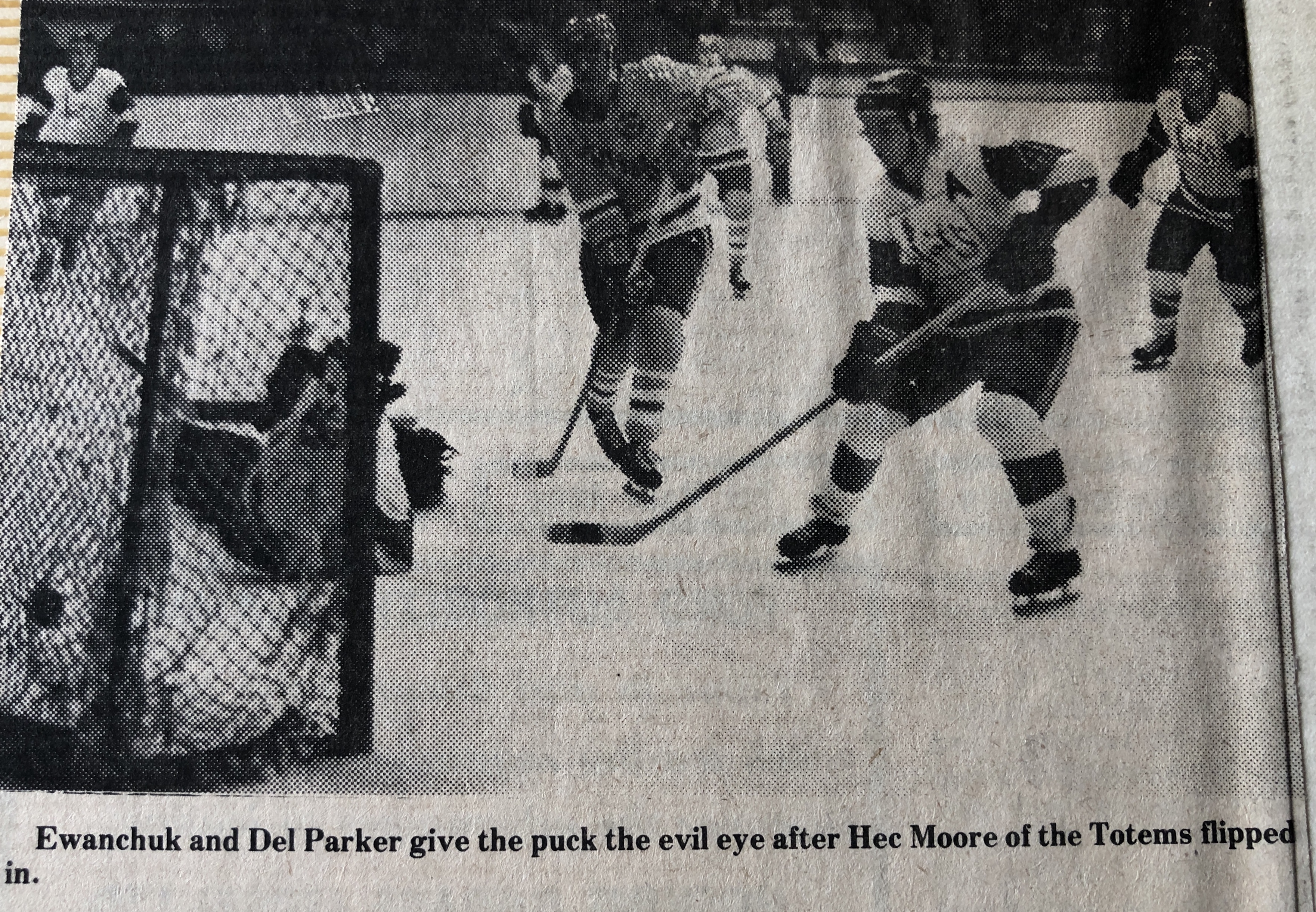
One Saturday night in late November stands out for me. We played the Houston Luckies at home in Smithers. They were a men’s team who went on to win it all that year. Houston and Smithers have a rivalry similar to that of Fort St. John and Dawson Creek so the pressure was on.
They beat us 16-4.
The newspaper was hard to read some days 😦
After the game, our captain who was a fifteen year old from Coquitlam, started the obligatory pep talk. He said, “Every Sunday morning I phone my parents and every Sunday morning I have to tell them we lost again”… and then he started to cry. It was like a contagious yawn… in seconds the whole room was in tears. The losing and homesickness were bubbling over. A short time later we gathered our composure and began the process of “psyching ourselves up” for our Sunday afternoon game against the same team. We came to the rink the next day ready to play.
If Hollywood had written the script we’d have won in front of a cheering home crowd. Instead, we lost 16-4 again.*
The next year about half of us returned to Smithers. The team’s name changed from Nat’s to Chiefs (because we were affiliated with the Kamloops Chiefs of the WCHL). The fact that we were a bit older and a bit bigger, combined with the addition of a few really good rookies, changed our losing ways. The homesickness wasn’t as bad either. Our record flipped from 12-28 in 1973-74 to 28-12 in 1974-75.
On a plane bound for somewhere…
Recently I’ve been in touch with a few of the guys. Our conversations have been so great. We all agree it was probably our age, losing and homesickness that brought us together and why, even though most of us would go on to play on several more teams, our time in Smithers had such a unique impact. We shared a lot of “firsts”… first time away from home, first stitches, first plane rides, first girl friends, and first heartaches. In a sense we grew up together.
I realize that I could go on and on… I could talk about the amazing Percy and Greta Benoit who were our billet parents for two years. I could do a bit of name-dropping and talk about the teammates who went on to play professionally. I could talk about how wonderful it was to arrive back in Montney after those first few months away…
Another day, perhaps.
I couldn’t resist posting these two. Sorry, Del.
*Several times over the years I’ve told the back-to-back 16-4 loss story to students and my own kids when they’ve suffered a tough defeat. (I don’t know if it made them feel any better or if they thought I was just trying to one-up their story!).
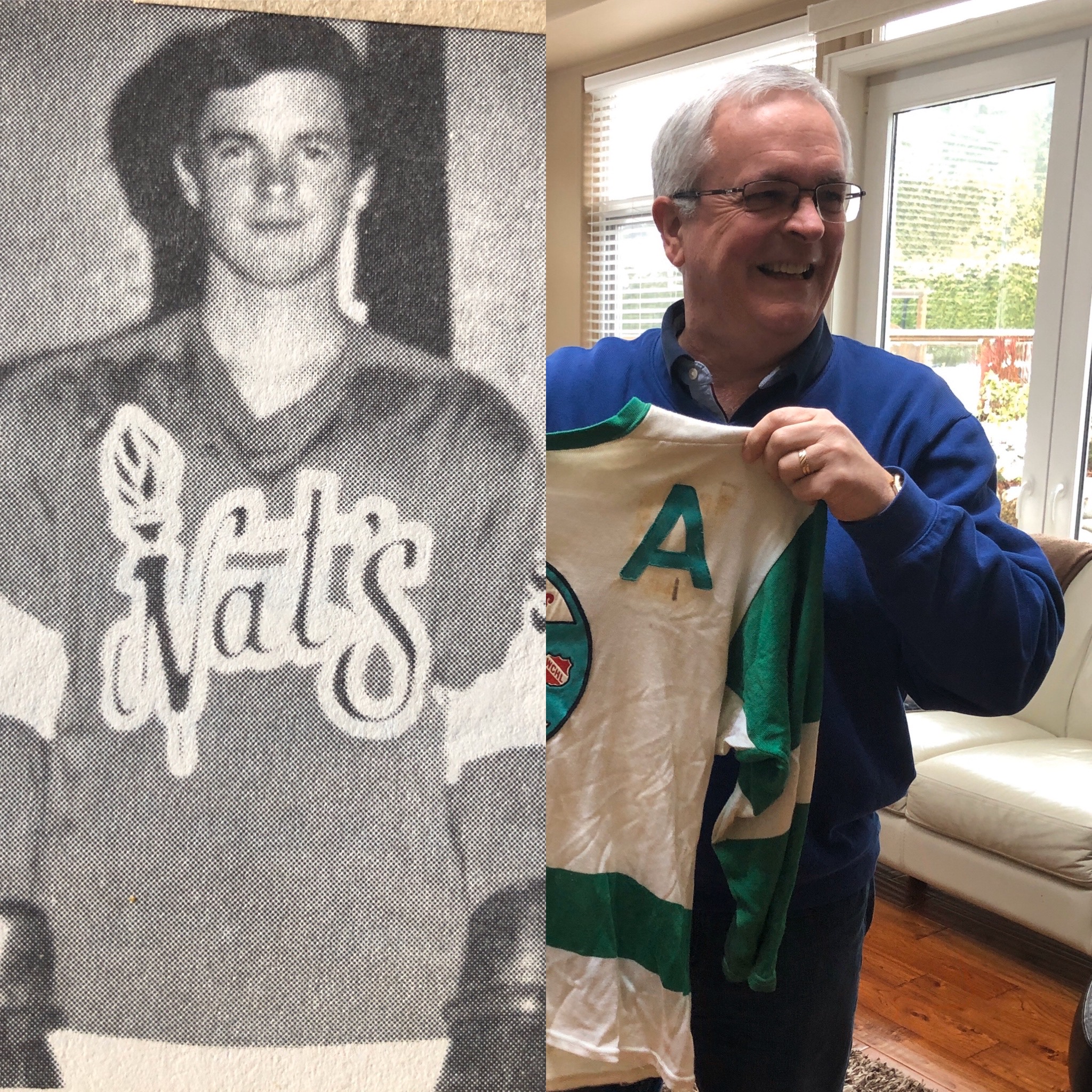
PS. I was so lucky that mom saved all of the newspaper clippings and pictures and made scrap books for each year. She must have missed me. 🙂
Dave… our 15 year old captain from Coquitlam. Then, and earlier this month. (He’s our “reunion chairman”!)
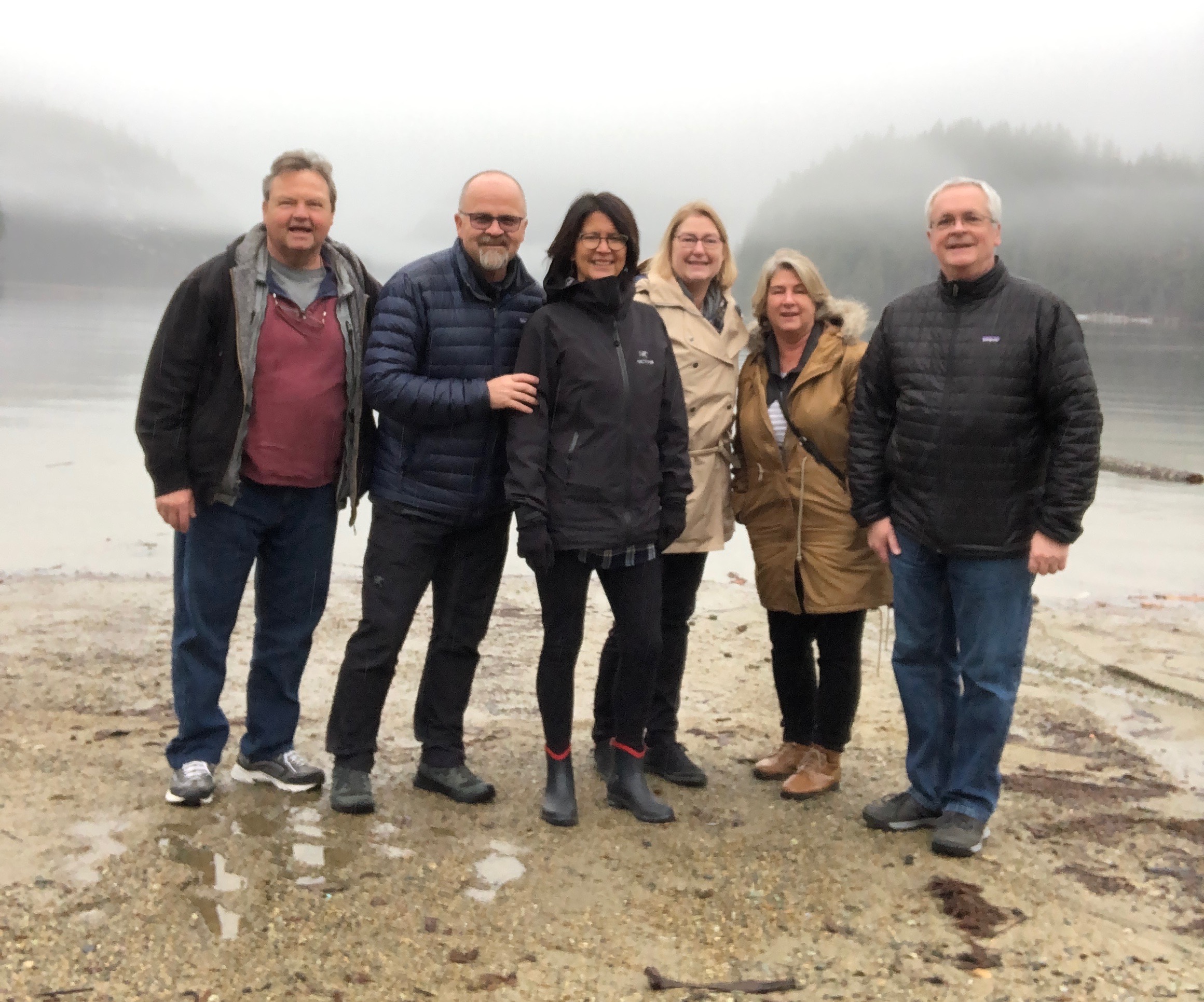
Kevin, me, Deb, Sylvia, Judy and Dave at our “reunion planning” session earlier this month.
Coach Joe Voytechek would say that several times at the end of every hockey practice. I can see him leaning against the boards near the penalty box in the Camrose arena… his whistle in one hand, note book in the other. He wore a red jacket and vintage skates. It was during the last minutes of practice that Joe would ask us to do one more lap. Inevitably we did five or six until he’d seen one with enough “feeling”. And then he’d smile.
The Camrose Arena… now called the Max McLean Arena
His practices were hard work. I’ve never been in better shape.
Joe coached me during the 1977-78 hockey season when I attended college in Camrose, Alberta and played for the Vikings.
By the time I met Joe, he was already a legend in Camrose having played for the Camrose Maroons (he was my dad’s hero when he went to school there) as well as coaching the 1974-75 Vikings to the Canadian Collegiate championship.
I don’t remember Joe spending much time in the dressing room, but when he was there he said things that were memorable. Memorable then, and maybe even more so now.
“Kopesetic, gentlemen. Kopesetic.” When he said this we knew that he was impressed by what he’d seen, and there was something about his manner that made me want to impress him.
He walked into the dressing room one time just as someone cursed loudly. He just kept walking but said, “There may be no ladies in this room but there might be some gentlemen.” He didn’t need to do or say anything more.
During the singing of the national anthem prior to each game it was Joe’s expectation that we stand completely still with our eyes on the flag. We did not move until the last strains of O’Canada were done. In some cases, when the organist or singer would drag the song out, we would be standing still on the blue line long after the other team had put on their helmets, tapped their goalie’s pads and skated to center ice for the opening face-off! I’ve not forgotten that and still find it hard to watch teams shuffle, spit, scratch or skate away before the anthem is over.
During a game late in the season I received my first ever 10-minute misconduct. Frustrated, I’d kicked the puck down the ice after the whistle. The referee took offence. To make matters worse, because it happened during the last 10 minutes of the game, the rules were such that I would have to sit out the next game as well. I was devastated and worried most that Joe would think less of me. Joe’s conversation with me after the game was calm, kind, and understanding. His big arm on my shoulder also spoke volumes.
Just over twenty years after my year with Joe and the Vikings I was working as a junior high school principal in Fort St. John. One morning, after a conversation with a student in my office, I thought of Joe. I thought of him and smiled because I realized that yet again I had used the word “kopesetic”. In fact, I thought of how many of his words and mannerisms had been right there in the back of my mind during conversations with students and staff. I decided to phone him.
I picked up the phone and dialed right away so that I wouldn’t be distracted by the many goings-on in a junior high school. Joe answered on the first ring. I told him it was Larry Espe calling. I could hear the smile in his voice when he said, “How are you doing, Esper*!”
I went on the tell him that he’d had a powerful effect on me as a coach and person. I told him that when he’d asked me to work at his hockey school in Bashaw, Alberta in the early 80’s I’d been flattered to no end. I told him that I was using his words and sayings on a daily basis, and that I still didn’t move a muscle until the anthem was over. I think I may have embarrassed him a bit but I also believe he appreciated the call.
I saw him only once since then for a brief visit while standing in his Camrose driveway.
Joe Voytechek, a consummate coach and gentleman, passed away at age 96 on January 12. My thoughts are with his sons (and my former Viking teammates), Wes and Jim and their family. Click to read Joe’s obituary…
Joe being inducted into the Alberta Colleges Athletic Conference (ACAC) Hall of Fame in 2017
* Joe called me “Esper”. I don’t remember anyone else calling me that.











 Recently, we found the almost-twenty-year-old cassette tape of their conversation. Luckily, we also found an old “ghetto-blaster” that would play it.




 “One more time, gentlemen. With feeling!”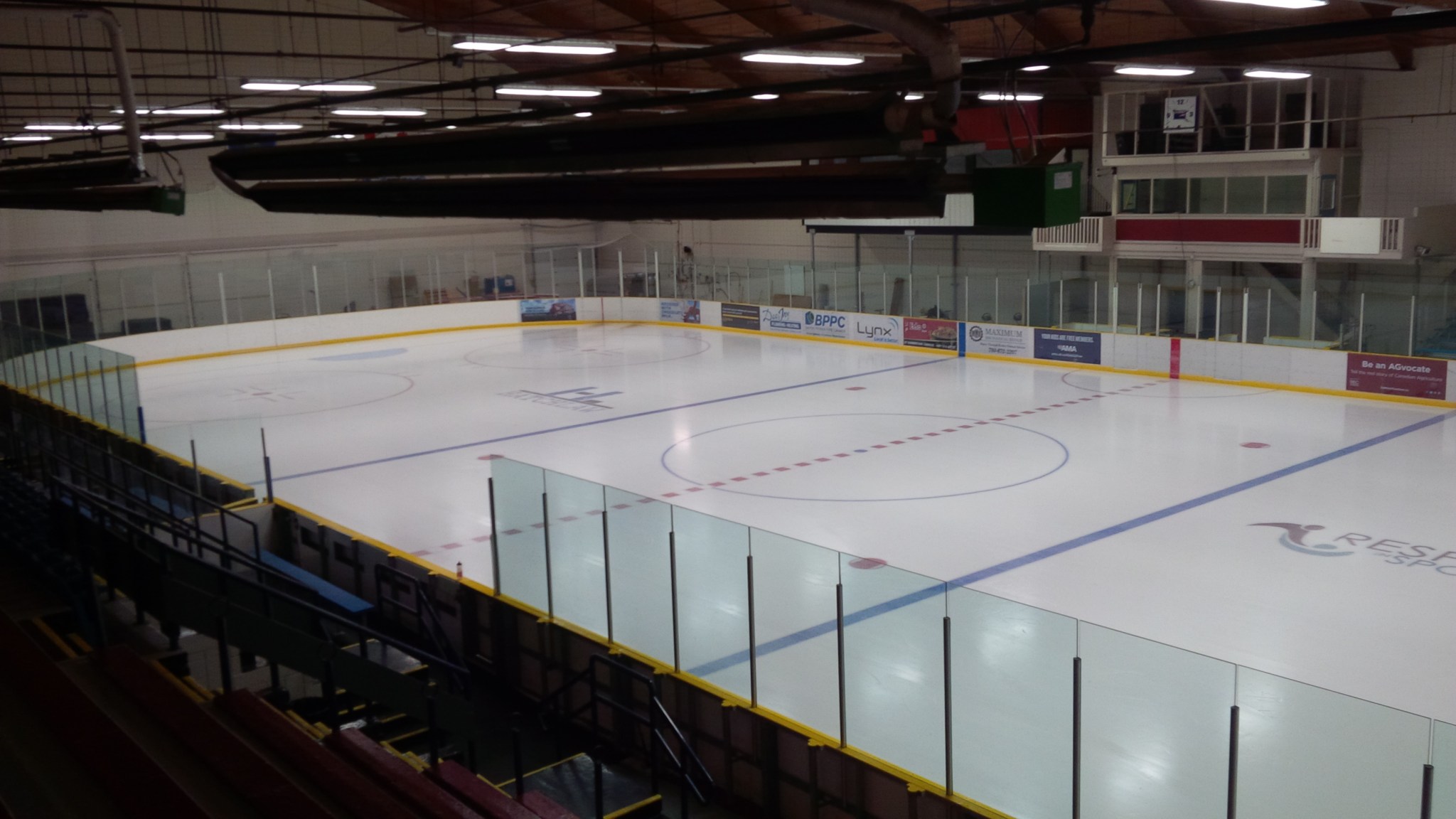


 Montney Boy