Author: montneyboy

A Montney boy teaches Science…

I started teaching in 1981 at Robert Ogilvie Elementary School in Fort St. John. My first classroom was an old green and white “portable” and I shared it with a group of almost thirty Grade 5 and 6 students. My education degree said I was a Social Studies / Physical Education teacher, but in my first classroom, I was on the hook for the whole show. Math, Spelling, French, Language Arts, a bunch of other things, and… Science.

Teaching science was going to be a stretch. It had never been an interest for me, I’d taken no science courses in university (other than some Kinesiology), and I’d spent most of my time talking during any high school science classes I’d taken.

So… there I was one September Sunday night planning for my first ever Grade 5/6 science lesson. I was to teach my kids about the “Scientific Method”.

The Scientific Method basically consists of these steps:

  • Question… You ask a question.
  • Hypothesis… You propose a “hypothesis” (this is a sort of educated guess about what you expect)
  • Experiment… You design and perform an experiment to test your hypothesis
  • Observations… You record your observations and analyze the data
  • Conclusion… Based on data, you conclude whether to accept or reject your hypothesis

Since there was no internet back in the day, and ministry approved curriculum guides were cumbersome and boring (they are much better now), I was wracking my brain for inspiration. It came in the form of a story I’d been told by a Montney old timer many years earlier. I decided to weave the Scientific Method into his story. I started with step #1 and went from there…

frog-jumpI told my students that the old Montney “scientist’s” question had been, “Is the distance a frog can jump affected if it loses one or more legs?”

He hypothesized that the distance a frog can jump will decrease in proportion to the number of legs it loses.

His experiment and observations (*all hypothetical, of course… remember, it’s a story!) went as follows…
He gathered the materials he needed. A measuring tape, pencil, chart paper, log book scalpel, and, of course, a frog. He drew a starting line at one end of the chart paper and placed the frog just behind it. On the count of three, he said, in a loud and commanding voice, “Jump, frog. Jump!” Scalpel-holder-chrome-for-scalpel-blades_b2
After the frog jumped, he quickly marked its landing spot with his pencil. He then measured the distance and recorded it in his log book. Next, using the scalpel, he carefully removed one of the frog’s legs. He then placed it back on the starting line and, once again in a loud and commanding voice, said “Jump, frog. Jump!”. When the frog landed he again used his pencil to mark the spot. The mark was some distance back from the first one.

The scientist repeated the same step twice more and observed that the distance the frog jumped decreased each time.  Finally, the frog sat legless on the start line. In a loud and commanding voice, the scientist said, “Jump, frog. Jump!”. The frog did not move. Again, in an even louder and more commanding voice, he said, “Jump, frog. Jump!” Again, no movement from the frog.

The scientist then walked over to his log book with his pencil to record his final observation and conclusion. He wrote, “If a frog loses all four of its legs… it becomes deaf.”

As far as jokes go, this one is certainly a groaner. Some might even call it “sick” or inappropriate. Whatever your opinion, this was an actual “lesson plan” concocted by me as a 23-year-old rookie. I guess I thought it was better than just “reading the chapter and answering the questions”. I’d like to think that some of those kids still remember the Scientific Method…

* no animals were harmed!


Making it real in Montney…

P1120120I feel incredibly lucky to have been raised in Montney. Living at the store meant that there were always people around. While people shopped, or drank coffee afterwards, their kids and I would get to play. We would play “catch”, shoot pucks in the garage or pound a few nails into the tree fort. We also spent hours imagining ourselves in all kinds of roles while exploring the wonderful maze of trees and bushes along the creek bank.
My friends envied parts of my life at the store (especially my access to the pop machine and candy counter), and I envied the things their farm homes allowed them to do.

I’ve often told people that my Montney friends thought I was a city-slicker because I lived “up-town”, while my Fort St. John friends thought I was a country-bumpkin for living “way out there”. It’s probably why I’ve needed so much counselling (just kidding!).

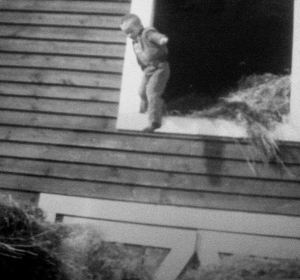
hay jump
Look, mom… no helmet!

Looking back, my identity crisis aside, an advantage of growing up in a community like Montney was how authentic everything was. I didn’t pretend to wait on customers, to stock shelves or fill propane bottles. My friends did not pretend to cultivate fields, drive combines or milk cows. Although I don’t think dad was overly impressed that we used up all of his good lumber, the tree fort we built involved real nails, hammers, saws, black finger nails and blood. It didn’t matter that our two-room school was somewhat traditional (straight rows and text books) because we all had ample opportunity to create, build, and fix things with our hands on our own time.

Screen Shot 2017-10-16 at 4.37.46 PM
One of many blackened nails…

I know this next part will sound like one of those old man stories (“I walked 5 miles to school… up-hill both ways”), but the truth is that kids today don’t generally have the same opportunities we had. A statistic from 4 years ago indicated that one in nine kids in British Columbia lives in a condominium. How many tree forts do they get to build? Schools should feel the pressure to provide more authentic, hands-on and collaborative learning experiences for kids at all levels. Universities should too.

The good news is that more and more teams of teachers are starting to work together, often outside of their comfort zones, to co-create interdisciplinary experiences that turn knowledge into understanding.Screen Shot 2017-10-16 at 4.10.41 PM

A Montney Start…

Screen Shot 2017-10-12 at 12.47.43 PMI was raised in Montney, B.C.  It’s where I started…

As superintendent of schools in SD #60 Peace River North I did my best to maintain a regular blog. Looking back, I’m glad I did. (http://www.leadership.prn.bc.ca). During my time working with the ministry I often contributed to a newsletter, but gave up my personal blog. Now, after four years of not having my very own, I thought I’d try again. No longer having a business card, or formal employer, I didn’t have a ready-made title. I’d like to share how I came up with one…

The unincorporated village of Montney is about fifteen minutes straight north of Fort St. John. My parents owned and operated the Montney General Store and we lived in the back.  Montney General StoreFrom the time I could see over the counter I took my turn waiting on customers and stocking shelves.

About 10 years ago, a friend of my son’s called to ask if he could buy me a coffee and talk about how I’d become a school superintendent. It wasn’t that he wanted to be one, I just think he’d read a self-help book that suggested he talk to some older guy who was a boss of some sort. I agreed to meet him, but after hanging up I realized that I wasn’t sure what I would tell him about my “trajectory”. I’d never aspired to be a superintendent (who does?!). The position basically “happened” to me. The coffee date made me think about how it “happened”. After more reflection than I probably had time for, I realized, more than anything else, my “Montney start” had provided me with some of my most important leadership lessons.

My parents, particularly my mom, had three specific expectations of me when I  worked in the store. The first was to call people by name (translates to… show people you care who they are). The second was to look people in the eye when talking to them (translates to… actively listen to people, especially in a world so full of distractions). The third, and maybe the hardest, was to smile even if I didn’t feel like it (translates to… remembering that the expression on your resting face can either pick people up or drag them down.) As much as anything else I ever learned, these three “soft skills” never let me down.

I’ve often told people how grateful I am that this Montney boy (and old hockey player who swears too much) was given the opportunity to see the education system from so many perspectives, and to have amazing conversations with wise and passionate people. My goal, with this blog, is to share some of the stories (the odd joke?), and lessons learned, since my “Montney Start”.

I guess the worst thing that can happen is that this becomes my journal and my grandchildren get a kick out of reading it someday. 🙂