Author: montneyboy

Making a Montney Moose Call

Screen Shot 2018-02-04 at 10.09.19 AM
A typical Montney moose

Although many of my Montney friends are hunters, I just never got in to it. However, as an avid photographer, I was interested in seeing wild animals up close. That’s why I was excited to learn how to make a Montney Moose Call (MMC for short). It’s a skill I’d like to share with you.

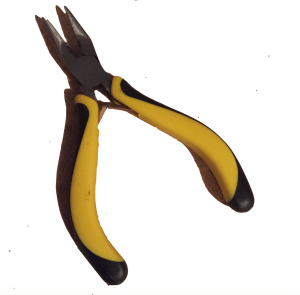
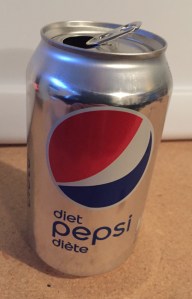
All you need to make your own MMC is a pop can and a pair of needle nose pliers. (Regular pliers will work in a pinch but are not optimal for the fine bending required.)
FullSizeRender-5 Screen Shot 2018-02-04 at 9.51.43 AM

Getting Started: The first step is to grip the pop can firmly and turn the pull-tab to 90’. Next, bend the pull-tab upwards while twisting it slightly to one side or the other. Twist back and forth gently until the entire pull-tab is removed. (It is important that the smaller tab does not break off as it is an integral part of the MMC).
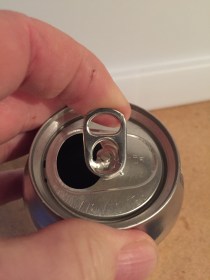
IMG_2989

(Beer cans may also be used, however because they are made with softer metal they are more difficult to work with. Notice the tearing in the picture below. The jagged and sharp edges may make your MMC dangerous to use.)
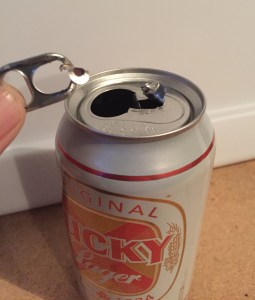
FullSizeRender-6


The pop can may now be recycled.

You will need your needle nose pliers for the next two steps. First, gently bend the small tab to a 90’ angle. This will act as the handle. Second, create the “mouth piece” by slightly bending the top of the tab backwards and away from the “handle” to roughly 30’ (this may require some slight adjustments in order to optimize volume and clarity).

FullSizeRender-4
Folding small tab to make the handle
FullSizeRender
Customizing the “mouth piece”

Your MMC is now ready to use. However, before proceeding, be sure you are in a safe location or, if you are hunting, that your rifle is loaded and ready to go.

Using the thumb and index finger of your dominant hand, place the largest hole of the tab gently against your lips until it is comfortable. (As I mentioned earlier, you may need to use your pliers to make slight adjustments).

The video below explains how to use your MMC:


The Backstory…

Although I learned how to make a moose call while I lived in Montney, it did not really originate there. My Uncle Jim Doonan, who lived south of the Peace River in Farmington, taught me how to make my first one when I was about 10 years old. I remember how he sent me running for pliers, needle nose pliers, a crescent wrench and a hammer before he was finally satisfied with it’s quality.

unnamed
Uncle Jim

I’ve made literally hundreds since. Many of them were made for unsuspecting students. I remember making one for a young lady who had won the CORE (Community Outdoor Recreation and Environment) award at Dr. Kearney Jr. Secondary sometime back in the 90’s. I made it in front of the whole school during the annual awards assembly. The sound of five hundred kids groaning in unison is still a fond memory.

My son also became a gifted moose call maker. Cy once called home from Australia to tell me that by making dozens of moose calls for his new friends from down under, he had “made Uncle Jim a legend”.

To this day, however, I have the most fun making moose calls for actual hunters who really think I’m going to make them something they can use. I measure how successful my “lesson” has been by the number of times I can send them back and forth to the garage to get the “right” tools for the job.

The educational slant? It is a hands-on skill that, in the right crowd, can be pretty engaging.

P.S.    The acronym MMC is a very recent (today) fabrication, and  I’m not really an avid photographer.


The Game Has Changed…


Screen Shot 2018-02-02 at 2.18.53 PMMy first year at the University of Alberta was Wayne Gretzky’s first year in the NHL. I was able to see a few games and, although the Oilers weren’t winning Stanley Cups yet, they were young, cocky and so very exciting to watch. Big win one night, big loss the next. Gretzky started setting records right away. In fact, to this day he still has more assists alone than the player next on the list has total points. He was good, to say the least. But if you’ve heard recent interviews, Wayne says that the game has changed and he’s not sure he would have been able to dominate in quite the same way today. He says this regardless of the rule changes that have reduced the amount of clutching, grabbing and holding that he had to endure.

Lester Patrick is the oldest person to ever play goal in the Stanley Cup Playoffs. He played in one game for theScreen Shot 2018-02-02 at 2.19.08 PM New York Rangers during the 1928 playoffs. As the Ranger’s coach and general manager, he was forced to put his 44-year-old self in net after the starting goalie suffered an eye injury. He allowed only one goal and the Rangers won the game, but his equipment alone tells me that a shot by any one of today’s pros could literally have been fatal. I actually think I could have scored on him.
Partly out of necessity, goalies today, are much better equipped, coached and trained. The size and quality of their equipment means fewer injuries. They are also able to cover much more of the net.

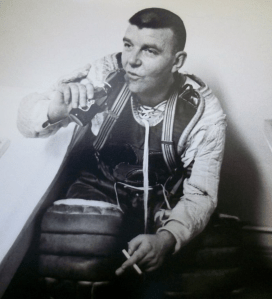
Screen Shot 2018-02-02 at 2.19.46 PMGump Worsley was another mask-less goalie from bygone days. He played for over 20 years in the NHL with New York, Montreal and Minnesota. He won the Vezina Trophy ( for best goaltender) twice, has his name on the Stanley Cup four times, and has been inducted in hockey’s hall of fame. He was considered one of best goalies of the 50’s and 60’s. I’m wondering if this dressing room picture of him with the cigarette and beer was taken before or after the game?!

Today’s players are more likely to be seen on stationary bicycles or in the weight room before and after games. Player fitness and strength have reached new levels. There was a time that players would attend fall training camps to “get in to shape”. Now, if they are not “in shape” when they arrive at camp their chances of making the team are reduced.

Screen Shot 2018-02-02 at 2.20.10 PM

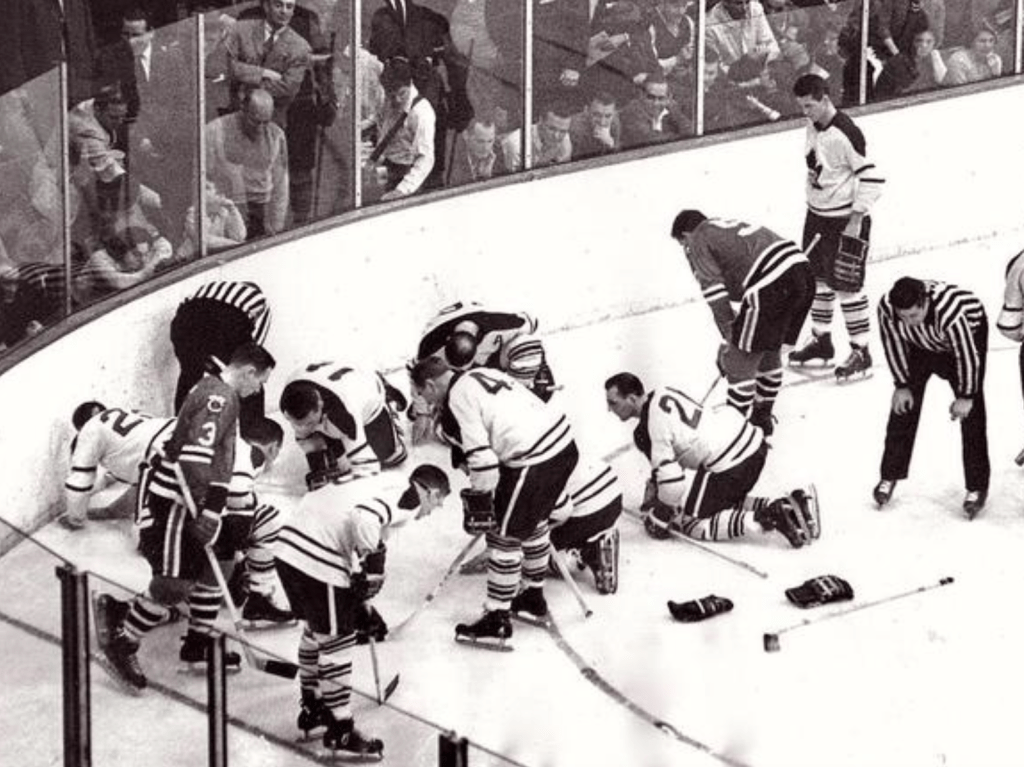
The picture above was taken in the 1960’s during a game between the Toronto Maple Leafs and the Chicago Blackhawks. At first glance, it looks as if there has been some sort of brawl, or that someone has been injured. However, if you look closely you will see that they are all looking for a missing contact lens. Today, it is laughable to think of a group of million-dollar hockey players on their hands and knees looking for something that you can get at Costco for less than a buck. Games no longer stop when someone loses a contact lens.

Sadly, the “game” of education (specifically the learning part) is still being stopped, delayed or disrupted by the time (and resources) spent looking for things that should have gone the way of expensive contact lenses. From parents, teachers and administrators at the school level, to auditors, bureaucrats and politicians at the government level, we still “look” for many things simply because that’s how we remember them, or how we’ve always done them. We still look for high school diplomas and college degrees based on hours of “seat time” rather than certifications indicating mastery of a specific skill or capability. We still look for traditional one-dimensional report cards full of letter grades and percentages, when we should be looking for demonstrations of learning that Screen Shot 2018-02-02 at 2.36.01 PMdisplay competency. The current system, created during the “age of average”, must give way to one based on what author Todd Rose refers to as “the jaggedness of individuality”. Rose believes “we no longer need to compel people to conform to the same inflexible standardized system because we now have the science and technology to build institutions that are responsive to individuality.” It basically comes down to, “When will what we know, change what we do… and what we look for?” Our game has changed too, and most of us know it whether we like it or not.

I believe we need to look for community members and business leaders who are willing to join teams of educators in conversations which respectfully question our system’s status quo, create genuine interdisciplinary learning opportunities for students, and develop competency based assessments. In my opinion, these teams will be the catalyst for transforming education at all levels, and for helping kids find their individual pathways and purpose… a purpose, or “reason for being”, that centres on what they are good at, what they love to do, what is good for our world, and what will put food on their table.

Screen Shot 2018-02-02 at 2.18.37 PM

P.S.     We’ve all seen fridge magnets, keychains and coffee mugs embossed with “It Takes a Village to Raise a Child.” The line has become somewhat of a cliche, but when I think back to the varied learning experiences provided to me while growing up in the Village of Montney (unicorporated), I realize how much the community influenced my life’s pathways and, to a certain extent, helped me find a purpose*.

(*I’m actually still looking!)


The Amazing Mrs. Nelson

I had the same teacher for Grades 4 through 7. Her name was Mrs. Nelson and she was amazing.mrs nelson

When I started school in 1964, the Montney School sat on a donated plot of land about half mile east of, and up the hill from, the Montney corner. The school consisted of just two classrooms. The “little room” for students in Grades 1 to 3, and the “big room” for those in Grades 4 to 7. There were also two “cloak rooms”. One for the boys and one for the girls. These were turned into washrooms with flush toilets and sinks with taps when I was in Grade 3. (Outhouses were used before that and were still used even after the renovation. I still remember the long metal trough in the boy’s outhouse that ensured there were no line ups when you needed to pee.) The only other room in the school that I can remember was a miniscule office for the teachers.

Mrs. Nelson was the principal and full time “big room” teacher for a few years before I started school and for the seven years that I was there. She “was” the school to me. She and her family lived on the grounds, just steps from the main building, in a “teacherage”.  I had some great teachers while in the “little room” (Mrs. Johnson, Mrs. Craig and Mrs. Cowger) but my most enduring memories are of the four years I spent in the “big room” with Mrs. Nelson.

With four grades in one room, she was more like a creative juggler than a traditional “sit and git” teacher. She must have spent hours in the classroom each evening and on weekends to be ready for us. The blackboards, full of her unique and beautiful handwriting, were waiting for us each morning.

Being in the same room for four years meant that I heard some things more than once… and it was wonderful.

It was clear to me that she loved the story of Ancient Egypt. As a Grade 4 student I listened wide eyed as she told stories about the Pyramids and King Tut. As a Grade 7 student my eyes were just as wide. I often hoped that she’d get to visit Egypt one day.

highwayman-001I remember her reciting “The Highwayman” by Alfred Noyes on several occasions. Her voice and timing brought the poem to life and you could hear a pin drop in the room as she spoke.   “And the highwayman came riding, riding, riding…”  I’ve read it to my kids (I don’t have it memorized like she did) and although they appreciated it, I know I didn’t give them the experience I had 😦
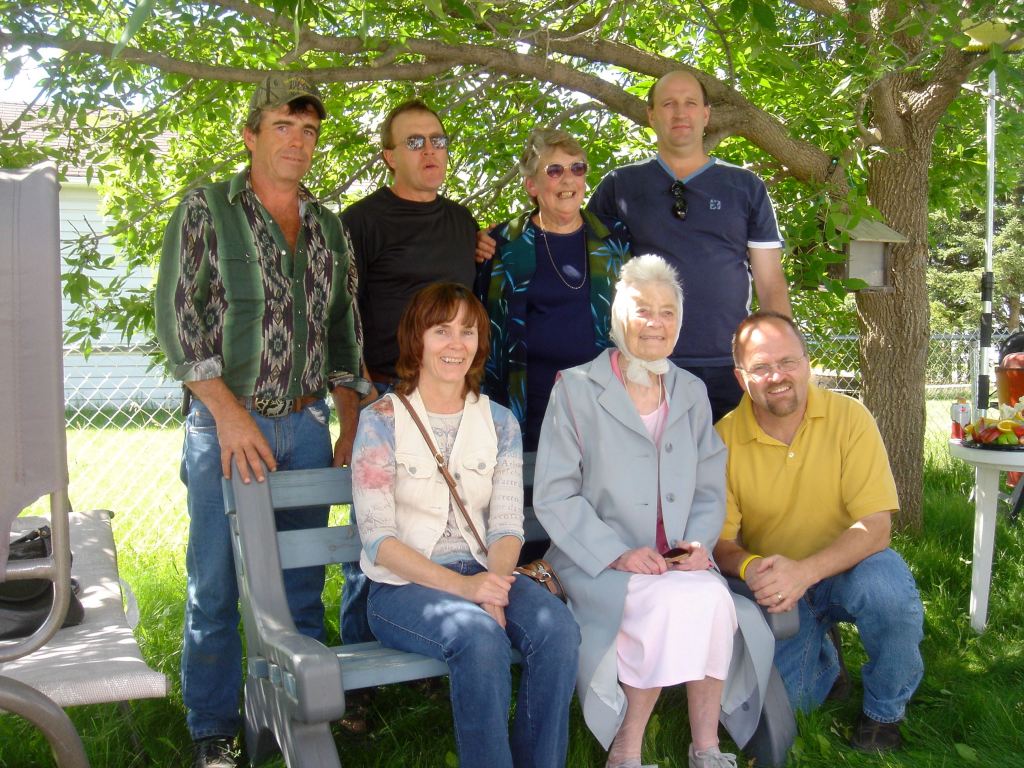
We didn’t have formal “Physical Education” but we played enormous amounts of soccer, fastball and hockey at recess and lunch time. A real treat though, was when Mrs. Nelson would tell us to put our work away well before the 3 o’clock bell and we’d all head outside to play Prisoner’s Base. She would stand on the sidelines, often in her long coat and scarf, and act as the referee. With a smile, she would decide if you’d been “tagged” or not. I don’t remember ever questioning her call.

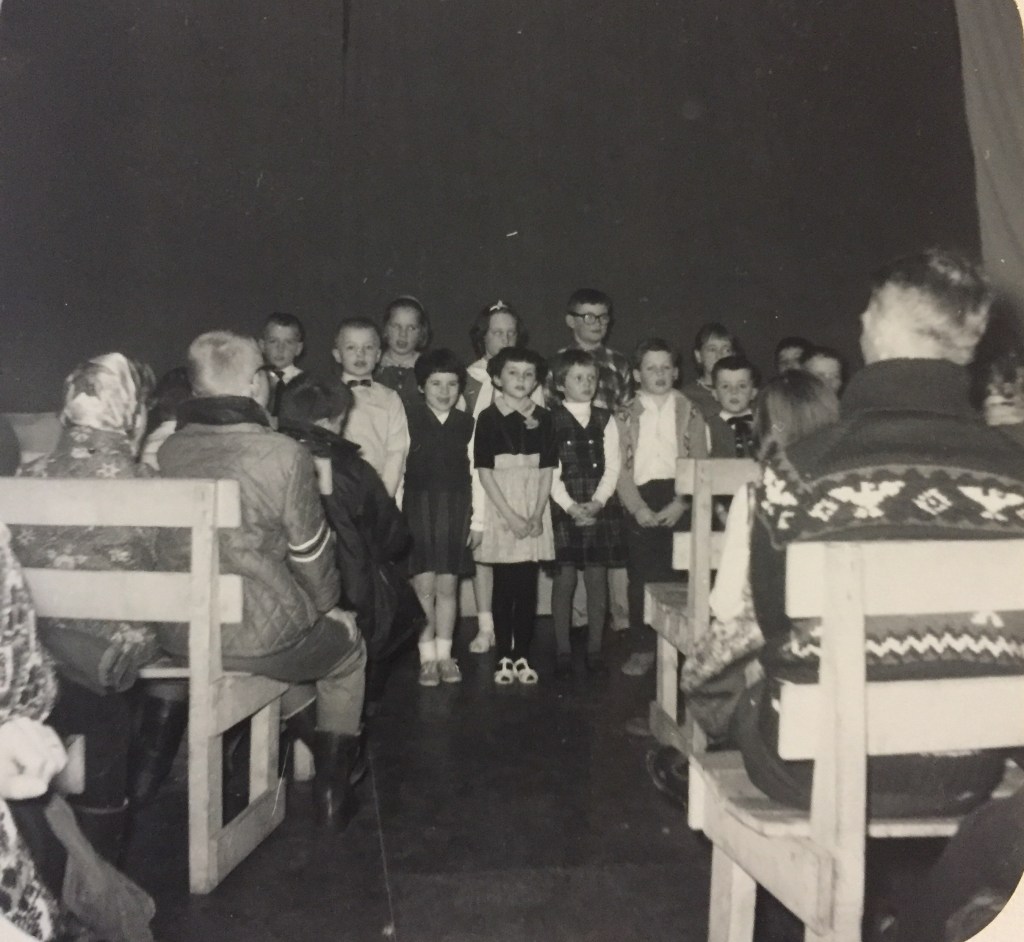
And then there were the Christmas concerts! It was obvious that music and drama were Mrs. Nelson’s passion. With her guidance, the whole school would start preparations in October. There were songs, recitals, and plays to rehearse. She directed the plays and I think she would often write or re-write them in order to include as many kids as possible. She played the piano and directed our “choirs” all at the same time. Back then I don’t suppose I appreciated all that she did, but I sure do now.

IMG_2874
L to R: Owen Myhre, Del Parker,Lolita Teteris,Debbie Jones,Vera Busche,Sherri Busche,Shannon Kearns, Guy Goodfellow, Phil Busche, Marilyn Bell, Shad Busche, ?, part of my head 🙂 (I’m not sure why we were in front of the stage. Setting up for a play behind it? )

Several times prior to the night of the concert, the whole school would be bussed to the “Montney Hall.” *  The stage, curtains, and chairs for the audience would be set up days in advance so that we could be ready for the big night. There was always a full house and, maybe because I was a kid, it seemed like we were in a huge theater or auditorium. It didn’t matter that the stage lights were made out of large tin cans that had been cut in half.

When I was in Grade 5 there were 45 of us in the “big room”. The people at the board office in Fort St. John decided that was too many kids… even for Mrs. Nelson. The next summer a “portable” was moved on to the school site. It was placed right next to the “Ice House” (which was no longer used for storing ice, but was great for playing Anti-I-Over). The “portable” housed students in Grades 4 and 5, which meant that for my last two years at Montney School I was in the “big room” with the rest of the Grade 6 and 7 kids and Mrs. Nelson.

That was also the year that the same board office crew determined that Mrs. Nelson was spending too much time preparing for the Christmas Concert and not enough on what was required for us to do well on standardized exams. I remember how sad she sounded when she explained that to us. She must have known the “soft skills” we were learning were important, because although we didn’t start to rehearse quite as early in the fall, the concerts were still amazing.

Like most teenagers, I was excited to jump on the bus and ride to town for Grade 8. Montney School became just a memory. A handful of years later it was closed when the new school at Upper Pine was built. Mrs. Nelson and her teacherage moved to Upper Pine too.

I saw Mrs. Nelson from time to time and I think she was happy that I’d decided to become a teacher. In June of 2005 I dropped in to Mrs. Nelson’s 85th birthday celebration along with a group of good friends who had also attended the school. She was wearing the same smile, and a scarf similar to the ones I remember. I told her how much she had influenced my life and career and held her hand for a moment. It was the last time I saw her. She passed away last May at the age of 97.

A mrs nelson
June, 2005 Back L to R: Shad Busche, Del Parker, Mrs. Barb Cowger, Owen Myhre Front L to R: Sherry Busche, Mrs. Shirley Nelson, me

Thinking of Mrs. Nelson makes me think of the many other educators and students who have influenced my life and my career. I don’t want to start a list for fear of forgetting anyone, but I want them to know they are the reason I’m still talking about education and respectfully questioning the status quo.

I thank Mrs. Nelson for telling me stories about Egypt, for making The Highwayman come to life, and for teaching me that a great many things can be learned by preparing for a Christmas concert.

(*Ironically, the Montney Hall was then located beside the store at the Montney corner. It now sits up the hill where the school used to be!).


Laughing… a family matter

bab3ff642bbe243f8f3858e1540dd304The only thing better than laughing until it hurts is watching people that you love laugh until it hurts.
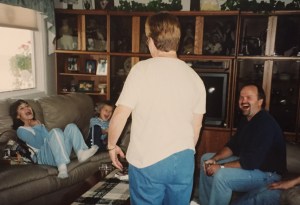
Laughing with my dad as we watched Tim Conway and Harvey Korman do the “new dentist sketch” might be one of my earliest and favourite memories of this. I spent half my time watching the TV screen and the other half watching Dad. He has an amazingly infectious laugh anyway, but Tim’s antics took it to a whole new level. Watching Korman try to keep a straight face just made everything even funnier.

FullSizeRender-1My mom had a great laugh too. In fact, many times she laughed “until the tears ran down her legs” (if you know what I mean). I can still see her running toward the bathroom giggling after being pranked by the “can-you-balance-a-coin-on-your-nose” trick.  Most of the time though, she was likely to be the one making you laugh. Singing “Chickery Chick, cha-la, cha-la” while standing on a footstool in the middle of the living room is one favourite memory. Another, although it didn’t seem that funny at the time, was when she flipped the main breaker during a Stanley Cup playoff game that dad and I were watching.

Seeing my kids laugh is pretty special. Cy, Britt and Makari have certainly heard more than their share of “dad jokes”. They didn’t really have a choice because I had years of practice telling recycled silly jokes to generations of kids at five different schools.

Reading to Makari at bedtime is something I still miss. As I read “chapter books” (that’s what she called books without pictures) I loved to watch how her eyes and face reacted as imagination turned words into pictures. I would try to match my voice to suit each character and the results would often have us both belly laughing. Her laugh is deep and reminds me of my grandmother, and her namesake, Kari.

Screen Shot 2017-12-18 at 9.12.49 AMHer YouTube channel, and her reporting for Black Press in Victoria tells me that her sense of humour has grown up as fast as she has.


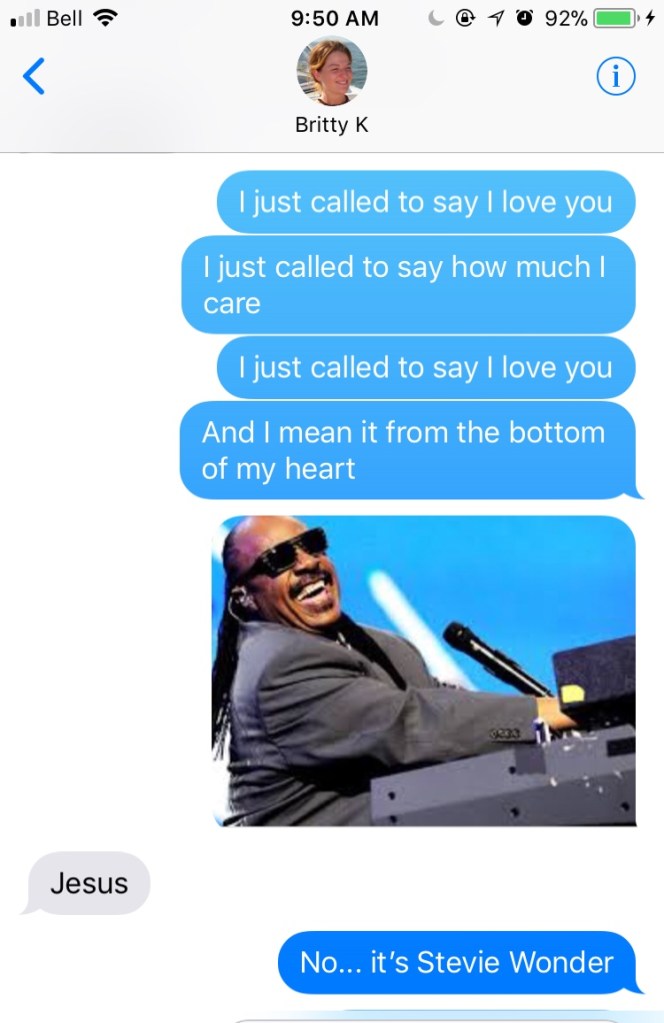
Britt has always been a wit. She still has an incredible way with words whether they be written, sung, off-the-cuff or said with an accent of some kind. Howard Gardner suggests that humour is considered a form of intelligence and Britt proves it. I am sure there must be times when she credits me for at least some of her sense of humour?? I tried calling her the other day and it turned into the following string of texts:

IMG_2476

My son might be the most like me. Cy is a storyteller. Always ready to string a line, he never lets the facts get in the way of a good story. For example, when Cy was an infant he had major stomach surgery which left a significant six-inch scar across his belly. For years that scar has allowed him to impress friends with stories about near-fatal bull rides and shark attacks. Six years of travelling the globe allowed him to spread BS world-wide! His laugh is similar to my dad’s and I love to hear it. Recently I “borrowed” a picture from the internet and passed it off as my own in a group-text to my family. I said that my wife, Deb, had asked me to “peel half the potatoes and boil them”.

Screen Shot 2017-12-07 at 9.35.57 AM

I guess this “dad joke” struck Cy’s funny bone and he literally laughed out loud. I have watched this video over and over:


The next generation arrived just over two years ago in the form of our granddaughter, Cove. She is an active little girl who already has a keen eye for what is funny. Her smile lights up a room and her laugh is already spectacular!

And finally, I have to thank Deb for never failing to laugh at my jokes or stories regardless of how many times she’s heard them. In fact, she blames me for the beautiful laugh lines around her eyes!

1004042_10151740070334739_1612599286_n


*Below are the links to two of my dad’s favourite all time “laugh til it hurts” clips, as well as the link to Makari’s YouTube Channel…

Click to see Tim Conway as the dentist!

Click to see the Blazing Saddles campfire scene!

Makari Espe YouTube

Rick Hansen… “Montney Boy in Motion”

Australia_Nike

Rick Hansen lived in Montney for a few months when he was in Grade 2. He and I were in the “Little Room” at the Montney school along with about thirty other kids in Grades 1 to 3.  Mrs. Craig was our teacher. I think she was about 75 years old.

Sometime during that year, Rick and his family moved to Williams Lake. His grandparents, however, continued to live in Montney. For the next few years, Rick would come to stay with them during the summer holidays… right up until the summer he was hurt.  He would play fastball with us on the Montney boys team and took part in several games and tournaments. He was by far our best player… pitcher, hitter, natural leader and nice guy.Used_softball_ball_in_Třebíč,_Czech_Republic

After his injury, it was a long time before I saw Rick again. I was away playing hockey when he came home to Montney for his grandfather’s funeral, as well as when he came back to Fort St. John to take part in the 1975 Northern BC Winter Games (He played table tennis in his wheelchair. There was no separate category for the disabled).

Rick-HansenBy the time I had a chance to speak to him again he’d become world famous as the “Man in Motion”. He spoke at a conference that I attended in Vancouver in the late 80’s. After his speech, which I remember as inspirational, funny and genuine, he ended up at a table quite near to where I was seated. At first, I was hesitant to approach him, being sure that he was tired of people from his past coming up to him with the “do you remember me?!” line. But, I overcame my Montney boy shy streak, and approached him. He put me at ease immediately. His face lit up, he called me by name, and right away he started to ask about how my family was doing. He also asked, by name, about all of the other Montney boys. As we shook hands and said good-bye he asked, “Larry, do you remember playing tag in the caragana bushes along the creek bank after ball practice?”. I said that I did. He said, “That was fun, eh?!”
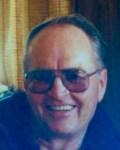
In 2012, Rick came to Fort St. John as part of his 25th Man in Motion Anniversary Tour. I was part of the committee that planned the event but, sadly, I had to be out of the country when he arrived. His visit was scheduled to include some formal meetings and a celebration at the Recreation Center but, as it turned out, he was also going to have some free hours on the morning of his second day in town. His secretary called to ask me if I’d like to organize a trip to Montney at that time. For a few minutes, I actually considered passing up my trip to China! After telling her that I had to be away, I guaranteed her that I could find some Montney boys who would be honoured to take Rick on a memory lane road trip. My buddies, Owen Myhre and Shad Busche did just that! They even arranged to take him to the house where his grandparents had lived all those years ago!

A few weeks after the tour, Rick’s secretary called me to ask if I would be free to take a call from Rick later that day. I said I thought I could find a minute or two (!!).  When he called he thanked me for the district’s part in planning his Fort St. John stop. He raved about his hours with Owen and Shad and then we talked for a while about being kids in Montney.  At one point, he asked how my dad was doing. Dad had coached our ball team back in the day.  23844813_10156135879956264_2544531556294759299_n (1)I said that he would be 80 on his next birthday and that he was doing fine.  Rick said, “Your dad is an amazing guy”.

I phoned Dad later that night.  I told him that Rick Hansen thinks he’s amazing.  I think I made his day.


Man in Motion – St. Elmo’s Fire video.

Check out Rick’s foundation.


What’s in a handshake?

In Montney, when I was a kid, handshakes were reserved for weddings and funerals. At least that’s how I remember them.

It wasn’t until I went to my first junior hockey training camp in Kamloops that I really noticed handshakes. I remember feeling a bit awkward at first, shaking hands so many times in a day. I sometimes felt it was a bit of a testosterone charged competition to see who could squeeze the hardest and maintain eye contact the longest. But maybe I was over-thinking it.Arm-Wrestling

After the hockey phase, my handshaking was once again limited to weddings, funerals, and when Norwegian relatives were visiting. Being an adult, I suppose I shook hands on more occasions than I remember but, let’s just say, I never gave handshakes much thought.

That all changed after hearing a presentation by a veteran English teacher from California. She talked about the importance of creating friendly relationships with students. One of her strategies was to greet each of them every time they arrived to her class with either a hug, handshake or simple pat on the shoulder. This was a sea change from the advice that many veteran teachers were still giving. They said things like, “don’t smile until Christmas… you’ll lose control!”

Bert-Bowes-Junior-Secondary-640x425Not long after the presentation I was appointed principal of Bert Bowes Junior Secondary School (coincidently, the same school I’d attended for grades 8 and 9!). With the Californian teacher’s words running through my mind, I decided to step outside of my comfort zone… I would say goodbye to students with a handshake as they left the school. I remember how awkward it felt for the first few days! I would stand by the main door in the middle of the hallway with my hand extended. I could tell that the kids felt awkward too… They would look at me as if I was a bit odd. Some, if they were from Montney, were probably wondering who was getting married or who had died! That being said, all but a few would warily extend their hand and say good-bye.


After a few days, it started to get easier. In fact, some kids were actually slowing down and purposely moving towards me to get their handshake. By the end of the month, I was actually creating a bit of a bottle neck at the door. In fact, I was having to become creative in order to keep up to the hands extended my way… left handed handshakes, behind the back handshakes, high fives… What made the handshakes special were the smiles that went with them and, because I always tried to learn kid’s names, this ritual became another chance to practice them.

By the time I left Bowes four years later, the afternoon handshake had become a bit of a tradition. I hated to be away from the school at dismissal time. The handshakes were good for my soul.

To this day I can always tell when I run into a student who knows me from my Bert Bowes days. They shake my hand.6685db1794ff1a7b3d64daa868ab6290

The handshake is said to have originated as a symbol of peace; a demonstration that neither “shaker” had a weapon in their hand. The purpose of one is to convey trust, balance, and equality. I think they do all of that. We are often advised to make sure our handshakes are “firm”. I guess I agree, however, “firm” to the point of being competitive, or aggressive, doesn’t’ do it for me. It shouldn’t be an arm-wrestle. I believe handshakes should be relationship builders and expressions of friendship. Maybe, “firm” should just mean that you mean it?


My Name is Larry Because My Dad’s Name is Hans…

As a boy, I spent a great deal of time with my Norwegian grandparents, Olaf and Kari. The “farm” was only two miles south of the store so visits were frequent and sleepovers were regular occurrences. Gramma had several albums full of black and white pictures of family and friends back “home” in Norway’s Jostedal Valley. I would spend many hours sitting beside her on the couch poring over the same pictures and hearing the same names and stories. I loved her accent and laugh… they brought the valley to life and colour to the pictures. She and Grampa also taught me Norwegian songs and rhymes that I still remember. I’ve always been proud of my Norwegian heritage.

grampagrammaboys
Grampa, Gramma, Dad and Uncle Thor… 1934

That being said, my name is Larry because dad’s name is Hans.

Dad was born in Canada in 1932. His parents had arrived from Norway in 1929. They homesteaded in the Montney valley in 1931. When Dad was born, his home-sick young parents named him after his paternal grandfather. The next year, they had a second son. He was named Thor after (you guessed it) his maternal grandfather. My grandparents didn’t speak much English nor did most of their Norwegian neighbours in the valley. As a result, dad and my uncle Thor, arrived at school speaking only Norwegian.

I heard many stories about Dad’s childhood, both from him and my grandmother, Kari when I was young. It sounded idyllic. Riding horses to school, playing in the creek, wearing bib overalls… It sounded kind of “Huckleberry Finn”’ish to me. I was sure his childhood had been as flawless as mine.

It wasn’t until I was older that Dad shared some of the downsides of growing up in the 1930’s. Like most, they had little money… Dad said he remembers getting only a Mandarin orange in his Christmas stocking one year. But it wasn’t the “dirt poor” stories that bothered me. I had a hard time when he told me about the prejudice he’d experienced because he was an “immigrant”… especially because some of it had been at the hands of people I knew or had known. He told me the stories with a grin on his face and I sensed that he no longer felt malice toward anyone, but I also knew that he’d been bothered by the incidents of teasing, bullying and exclusion.

By the time I was born in 1958, Dad was a tall, blue-eyed, handsome 24-year-old man (I’m not sure what happened to me!). He was no longer being teased about his name or bullied because he was an immigrant’s kid. However, when it came to picking a name for me, Dad wanted me to have anything but a Norwegian name. In 1958, the name “Larry” ranked 22 on the Top 100 Boy’s names list (Apparently, in 1949 it climbed as high as #10!). It was exactly the kind of name Dad was looking for… an “American” sounding name. larry's barber shop 1.29.19 PMYou know, like “Larry’s Pool Hall,” or “Larry’s Barber Shop”… Larry wasn’t an immigrant’s name.
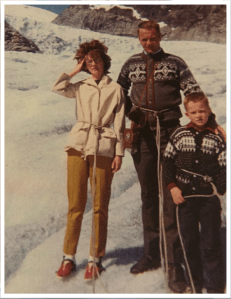
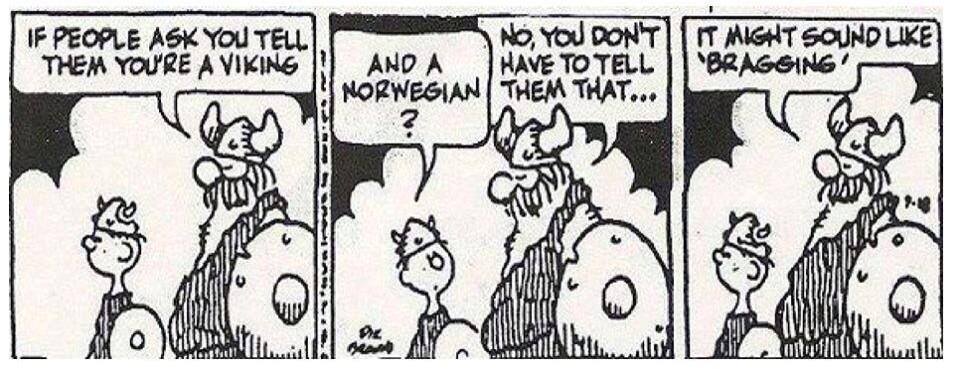
In 1967, Dad and Mom took my sister, Carol and me to Norway. It was a first trip for all of us… including Dad. He was 35 when he met all of his aunts, uncles and cousins for the first time. He never did meet any of his grandparents (sadly, his maternal grandmother passed away just months before we arrived). It was an amazing and emotional six weeks. Dad came home wearing a Scandinavian sweater… he still looks good in one. Dad went on to became an active member of the Sons of Norway and at one point served as president. I think if he had it to do over again, my name would be Hans, or Olaf, or Lars. That would suit me just fine.

Screen Shot 2017-10-20 at 12.55.01 PM
Mom, Dad and me walking on the glacier in Jostedal, Norway… 1967

I can say that I never experienced prejudice of any kind growing up. I think having white skin and blue-green eyes may have helped. Looking back, I know that my First Nations and visible minority friends wouldn’t say the same thing.

I take my hat off to the people and programs in schools and communities who are doing all they can to make sure that immigrants to our country, and especially their children, are never made to feel ashamed of their own first names. “Settlement Workers in Schools” (SWIS) is one such program…

http://www.meetfortstjohn.com/life-in-fort-st-john/public-schools/swis-settlement-workers-in-schools

994115_789111561122065_5201964739327256757_n


Montney boys can play hockey… just sayin’

The picture of me in the leafs jersey at the top of this page just got me into trouble. Turns out my buddy Del visited the site and noticed that he’d been cut out of the picture… 😦 . A couple of things added salt to his wound… his mom had actually taken the picture of the two of us… AND we were skating on one of his family’s “scoop-outs” just east of the Montney corner. (I really do feel badly, but I didn’t think he’d mind because he’s skating on at least one of his ankles.)FullSizeRender-1

Actually, Del and I ended up playing a lot of hockey together. After starting on “scoop-outs” like this one and the out-door rink at the Montney school, together we went on to play minor hockey in Fort St. John and Junior B hockey in Smithers. Del went on to play Junior A while I played college hockey in Alberta, but after that we got together again to play for the Fort St. John Flyers, rec league teams, and, ultimately, an old timer’s team. In fact, someday it would be fun to sit down with a beer and try to remember all of the rinks we skated on together… from Whitehorse to Victoria and points between.

It needs to be said that Del was a better hockey player than me. He won more trophies and played at a higher level than I did. In fact, if it hadn’t been for a serious knee injury, I think he could/should have played professional hockey at some level. But then… his mom didn’t smoke when she was pregnant like mine did*.

Montney, and its little outdoor rink beside the school, gave a lot of us the opportunity to learn the game. Parent volunteers, like my dad, spent hours flooding the ice and building boards. I remember evenings when parents would park their cars with their headlights shining onto the ice so that we could play until we got too cold. In the spring time, we would skate along the edges; on the ice protected from the sun by the shade of the boards.

18118847_10155381472984739_3781384849417372798_n
1969-70 Ross H MacLean Pee Wee Reps
The extra ice-time must have helped because in 1970, when the Fort St. John Pee Wee Rep team took third place at the BC provincials in Victoria, five of the fifteen of us were Montney boys.

A few years ago, the same five were able to play together at an old-timer’s tournament in Taylor, B.C.  I don’t remember for sure, but we must have won the tournament?!

12764345_10154079614624739_2763758270343629418_o
(L to R) Del Parker, Ron Payou, Owen Myhre, me, Phil Busche
 (* totally kidding!)

A Montney boy teaches Science…

I started teaching in 1981 at Robert Ogilvie Elementary School in Fort St. John. My first classroom was an old green and white “portable” and I shared it with a group of almost thirty Grade 5 and 6 students. My education degree said I was a Social Studies / Physical Education teacher, but in my first classroom, I was on the hook for the whole show. Math, Spelling, French, Language Arts, a bunch of other things, and… Science.

Teaching science was going to be a stretch. It had never been an interest for me, I’d taken no science courses in university (other than some Kinesiology), and I’d spent most of my time talking during any high school science classes I’d taken.

So… there I was one September Sunday night planning for my first ever Grade 5/6 science lesson. I was to teach my kids about the “Scientific Method”.

The Scientific Method basically consists of these steps:

  • Question… You ask a question.
  • Hypothesis… You propose a “hypothesis” (this is a sort of educated guess about what you expect)
  • Experiment… You design and perform an experiment to test your hypothesis
  • Observations… You record your observations and analyze the data
  • Conclusion… Based on data, you conclude whether to accept or reject your hypothesis

Since there was no internet back in the day, and ministry approved curriculum guides were cumbersome and boring (they are much better now), I was wracking my brain for inspiration. It came in the form of a story I’d been told by a Montney old timer many years earlier. I decided to weave the Scientific Method into his story. I started with step #1 and went from there…

frog-jumpI told my students that the old Montney “scientist’s” question had been, “Is the distance a frog can jump affected if it loses one or more legs?”

He hypothesized that the distance a frog can jump will decrease in proportion to the number of legs it loses.

His experiment and observations (*all hypothetical, of course… remember, it’s a story!) went as follows…
He gathered the materials he needed. A measuring tape, pencil, chart paper, log book scalpel, and, of course, a frog. He drew a starting line at one end of the chart paper and placed the frog just behind it. On the count of three, he said, in a loud and commanding voice, “Jump, frog. Jump!” Scalpel-holder-chrome-for-scalpel-blades_b2
After the frog jumped, he quickly marked its landing spot with his pencil. He then measured the distance and recorded it in his log book. Next, using the scalpel, he carefully removed one of the frog’s legs. He then placed it back on the starting line and, once again in a loud and commanding voice, said “Jump, frog. Jump!”. When the frog landed he again used his pencil to mark the spot. The mark was some distance back from the first one.

The scientist repeated the same step twice more and observed that the distance the frog jumped decreased each time.  Finally, the frog sat legless on the start line. In a loud and commanding voice, the scientist said, “Jump, frog. Jump!”. The frog did not move. Again, in an even louder and more commanding voice, he said, “Jump, frog. Jump!” Again, no movement from the frog.

The scientist then walked over to his log book with his pencil to record his final observation and conclusion. He wrote, “If a frog loses all four of its legs… it becomes deaf.”

As far as jokes go, this one is certainly a groaner. Some might even call it “sick” or inappropriate. Whatever your opinion, this was an actual “lesson plan” concocted by me as a 23-year-old rookie. I guess I thought it was better than just “reading the chapter and answering the questions”. I’d like to think that some of those kids still remember the Scientific Method…

* no animals were harmed!


Making it real in Montney…

P1120120I feel incredibly lucky to have been raised in Montney. Living at the store meant that there were always people around. While people shopped, or drank coffee afterwards, their kids and I would get to play. We would play “catch”, shoot pucks in the garage or pound a few nails into the tree fort. We also spent hours imagining ourselves in all kinds of roles while exploring the wonderful maze of trees and bushes along the creek bank.
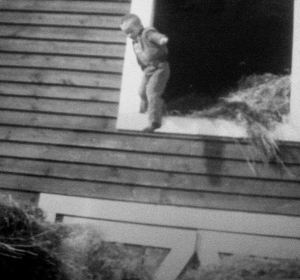
My friends envied parts of my life at the store (especially my access to the pop machine and candy counter), and I envied the things their farm homes allowed them to do.

I’ve often told people that my Montney friends thought I was a city-slicker because I lived “up-town”, while my Fort St. John friends thought I was a country-bumpkin for living “way out there”. It’s probably why I’ve needed so much counselling (just kidding!).

hay jump
Look, mom… no helmet!

Looking back, my identity crisis aside, an advantage of growing up in a community like Montney was how authentic everything was. I didn’t pretend to wait on customers, to stock shelves or fill propane bottles. My friends did not pretend to cultivate fields, drive combines or milk cows. Although I don’t think dad was overly impressed that we used up all of his good lumber, the tree fort we built involved real nails, hammers, saws, black finger nails and blood. It didn’t matter that our two-room school was somewhat traditional (straight rows and text books) because we all had ample opportunity to create, build, and fix things with our hands on our own time.

Screen Shot 2017-10-16 at 4.37.46 PM
One of many blackened nails…

I know this next part will sound like one of those old man stories (“I walked 5 miles to school… up-hill both ways”), but the truth is that kids today don’t generally have the same opportunities we had. A statistic from 4 years ago indicated that one in nine kids in British Columbia lives in a condominium. How many tree forts do they get to build? Schools should feel the pressure to provide more authentic, hands-on and collaborative learning experiences for kids at all levels. Universities should too.

The good news is that more and more teams of teachers are starting to work together, often outside of their comfort zones, to co-create interdisciplinary experiences that turn knowledge into understanding.Screen Shot 2017-10-16 at 4.10.41 PM